.png?width=44&height=44&name=joomag%20favicon-blue%20(2).png)
Your new collection is live. The photography is strong, the merchandising team signed off, and the PDF catalog went out on schedule. Then the familiar problem shows up. You can’t tell who opened it, which pages held attention, where buyers dropped off, or whether the catalog influenced any revenue at all.
That’s the gap most footwear teams are still operating inside. They’re publishing a document when they should be building a shopping experience. For catalogs for shoes, the difference matters more than it does in many other categories because buyers need help with fit, material, styling context, and confidence before they commit.
A shoe catalog that performs isn’t just attractive. It shortens the path from discovery to purchase, reduces hesitation, collects first-party data, and gives both ecommerce and sales teams useful signals. When brands treat the catalog as part of the conversion system rather than a design artifact, results usually improve in the places that matter most: returns, buyer confidence, sell-through quality, and follow-up precision.
Why Digital Shoe Catalogs Still Matter in 2026
The catalog has always mattered in footwear because shoes are hard to buy on description alone. Buyers want to compare shape, outsole, profile, color, and intended use quickly. They also want reassurance that a specific style will fit their body and their life.
That’s why catalogs for shoes still have strategic value. The format solved a real distribution problem long before digital commerce existed. The first mail-order catalog launched in 1872, and that shift helped remote consumers access a footwear market that later grew into a U.S. category worth over $100 billion in 2021, within a global footwear market projected to reach $550 billion by 2026 according to this historical review of footwear commerce.
The difference now is visibility. A print-era catalog could inspire demand, but it couldn’t report back. A static PDF still has the same weakness. It might look polished, but it rarely tells you which product group held interest, which retailer revisited the line sheet, or which story moved a buyer toward action.
Static files create blind spots
A flat PDF usually fails in four ways:
- No behavioral data: You don’t know which styles people viewed most.
- Weak mobile experience: Pinching and zooming kills momentum.
- No direct path to action: Buyers have to leave the file to shop, inquire, or request terms.
- No segmentation value: Sales teams can’t prioritize outreach based on actual content engagement.
A shoe catalog should answer two questions at once: what does this product look like, and what should the buyer do next?
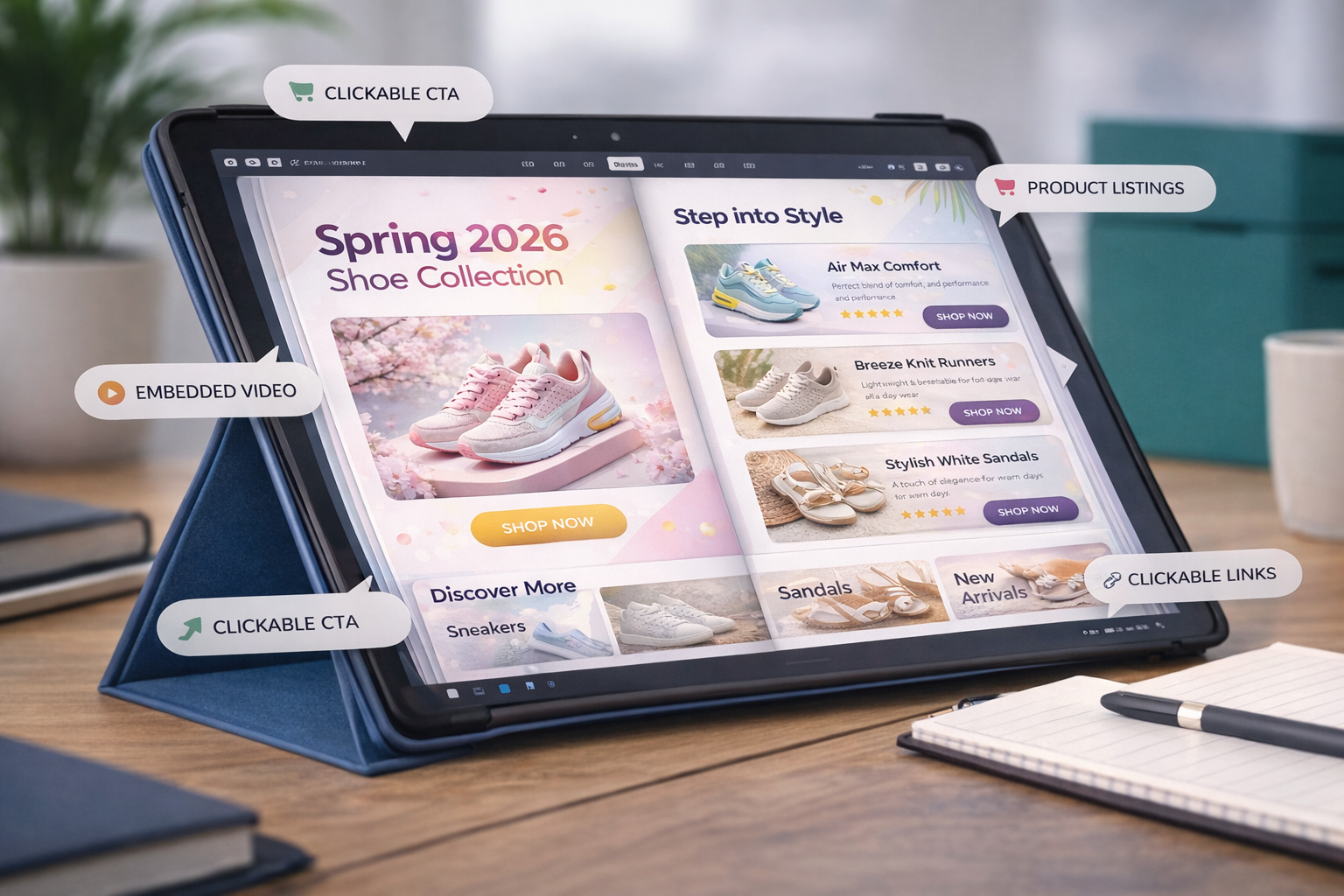
That’s where interactive publishing changes the economics. A digital catalog can function as a branded environment with hotspots, embedded video, forms, product links, and reader analytics. If you want to see how teams structure that transition in practice, Joomag’s digital content case studies show the broader operational model behind measurable publishing.
The modern role of the catalog
For footwear brands, the catalog now sits between merchandising, ecommerce, and sales enablement. It can launch a collection, support wholesale appointments, qualify buyer interest, and capture first-party intent data without forcing the audience into a clunky sequence of tabs and attachments.
That makes the digital catalog less like a brochure and more like a controlled conversion layer.
Strategic Planning for Your Shoe Catalog
Most shoe catalogs underperform before design starts. The team jumps into page layouts, then tries to bolt on goals later. That’s backwards. Strong catalogs for shoes begin with commercial intent, not aesthetics.

Start with one commercial job
“Sell more shoes” isn’t useful. A catalog can support many jobs, but each edition should have one primary role.
In practice, that usually falls into one of these buckets:
| Catalog type | Primary outcome | Content emphasis |
|---|---|---|
| DTC launch catalog | Faster product discovery and purchase | Styling, fit support, product storytelling |
| Wholesale sell-in catalog | Better rep conversations and account follow-up | assortments, specs, wholesale-ready product groupings |
| Lead generation catalog | Reader identification and form fills | gated access, value-led editorial framing |
| Retail enablement catalog | Better in-store or partner alignment | collection logic, product education, key talking points |
If you try to make one catalog do all four, it usually becomes bloated. The buyer gets mixed signals, and your team can’t tell what “success” means.
Merchandising should tell a story
A catalog isn’t your inventory export. It’s a guided path through the collection.
That means organizing products around how people buy shoes:
- By use case: running, travel, office, trail, occasion, recovery
- By wearer need: stability, cushioning, lightweight, wide-width, easy-on
- By seasonal story: spring color drop, holiday dress edit, back-to-school essentials
- By margin priority: hero styles first, supporting units second
The strongest catalogs for shoes create visual rhythm. They move from aspiration to specification. A reader sees the shoe in context, then gets the practical information needed to act.
Practical rule: If a style appears in the catalog, give it a clear role. Hero product, basket builder, credibility piece, or niche solution. Don’t include SKUs just because they’re available.
Build around real audience segments
A wholesale buyer, a comfort-footwear shopper, and a fashion-conscious repeat customer don’t read the same way. The structure, copy density, and CTA logic should reflect that.
A few examples:
- Wholesale accounts want quick assortment understanding, margin-friendly grouping, and easy ways to request more information.
- Consumer shoppers need confidence cues, simple navigation, and obvious product links.
- Niche-fit audiences need reassurance that the brand understands their needs, not just that it stocks a rare size.
That last point is underused. There’s a meaningful opportunity in underserved footwear segments. Wide-width and orthopedic categories often get poor digital treatment even when demand is steady. According to this analysis of underserved footwear niches, brands that create user-friendly digital catalogs for sizes like 2E or 4E with interactive sizing support can see estimated conversion lifts of 20-30% by serving unmet demand.
Pick your edge before competitors define it for you
If your catalog looks like every other seasonal lookbook, buyers will compare you on price or aesthetics alone. That’s a weak position.
A stronger plan usually leans into one advantage:
- Fit clarity
Useful when your assortment spans technical, performance, or comfort categories. - Lifestyle authority
Useful for premium, fashion, or occasion-led collections where styling context drives interest. - Niche expertise
Useful for wide-width, orthopedic, diabetic-friendly, or other underserved fit segments. - Speed to buy
Useful when product discovery is your bottleneck, not awareness.
Define what the catalog must capture
Before production, list the signals you want back from readers. Not vanity metrics. Business signals.
Use a planning checklist like this:
- Reader identity: Are you capturing named leads, anonymous engagement, or both?
- Product interest: Which categories, styles, and pages matter most?
- Sales readiness: What behaviors should trigger rep follow-up?
- Fit friction: Where do readers hesitate or seek more sizing help?
- Audience differences: Do retailers, distributors, and end consumers engage differently?
If the team can’t answer those questions in advance, analytics later won’t help much. You’ll collect activity without insight.
Designing an Immersive Footwear Experience
Footwear design content lives or dies on visual trust. Buyers can’t touch the upper, flex the forefoot, or inspect the stitching. Your catalog has to do that work on screen.

A lot of teams still design catalogs for shoes as if they were print spreads exported online. That creates beautiful pages and weak buying experiences. Digital layout needs to favor comparison, tap targets, and quick visual understanding.
Make the shoe the hero
Footwear buyers notice shape fast. Toe profile, outsole thickness, collar height, and material finish register before they read a single spec. So the layout has to prioritize product visibility over decoration.
That usually means:
- Clean framing: generous white space around the product
- Consistent angles: lateral, top, outsole, and on-foot views where relevant
- Disciplined cropping: don’t let fashion styling obscure construction
- Material clarity: suede, mesh, leather grain, knit, and trim need close-up support
One product image is rarely enough. For shoes, image variety does the job copy often can’t. A lifestyle shot helps the reader imagine use. A technical close-up answers the objection.
Mobile-first wins more often than magazine-style layouts
Many teams say they’re mobile-aware. Fewer design for thumb behavior.
A mobile-first catalog for shoes should make these choices:
| Design choice | What works | What usually fails |
|---|---|---|
| Page density | Fewer products per screen | Cramped multi-product spreads |
| Product details | Expandable layers or pop-ups | Tiny text blocks under each item |
| Navigation | Clear category jumps | Long sequential flipping |
| CTA placement | Close to the product image | Buried at page bottom |
A shoe shopper won’t work hard to decode your page. If the path to understanding feels slow, they leave.
Show fit and feel without overexplaining
The hardest part of footwear merchandising is translating physical sensation into visual and editorial cues. You can’t recreate wear experience perfectly, but you can reduce uncertainty.
Use a mix of assets:
- On-model imagery for proportion and silhouette
- Close crops for texture, finish, and construction details
- Use-case shots that show the shoe in the environment it was designed for
- Short video loops when movement matters, especially for flexible uppers or lightweight styles
If the catalog only shows beauty shots, buyers assume you’re hiding the details that matter.
Copy should support decisions, not narrate every product
Product descriptions in shoe catalogs often miss in one of two directions. They’re either too sparse to help or so dense they slow the reader down.
A better structure is layered:
- Headline benefit
One clear statement of what the shoe is for. - Material or construction cue
Enough detail to support quality perception. - Fit or wear note The line buyers care about when they’re close to purchase.
- Action option
Shop, request, save, compare, or contact.
This keeps the page scannable while still giving substance.
Templates versus custom builds
Teams often debate whether to build a custom catalog from scratch or use a structured publishing workflow. The answer depends on how often you publish and how much variation you need.
Custom layout makes sense when:
- You’re launching a flagship collection.
- Brand expression is a major differentiator.
- You need highly bespoke editorial pacing.
Template-led production makes sense when:
- You publish often.
- Multiple teams contribute content.
- Speed, consistency, and version control matter more than novelty.
If your team needs to turn PDFs or templates into mobile-optimized interactive publications, tools such as interactive digital publication platforms can support that workflow while preserving brand structure and adding digital layers.
Build visual rules before the first page
Catalog production gets expensive when every spread becomes a new argument. Lock your rules early.
Create standards for:
- image ratio
- background treatment
- callout style
- button placement
- color coding by category
- typography hierarchy
- how fit information appears across styles
That consistency helps shoppers scan faster. It also helps your internal team produce future editions without starting over every season.
Turning Browsers into Buyers with Interactivity
Design gets the click. Interactivity gets the sale.
For catalogs for shoes, this isn’t a nice extra. It’s how you remove the friction that keeps readers in browsing mode. Shoes create hesitation for predictable reasons: fit uncertainty, product comparison fatigue, and the need to inspect details before committing. Interactive layers solve those issues better than static pages ever will.

Add shopping actions at the moment of interest
A buyer should be able to act while interest is high. That means placing action where attention already is, directly on or beside the product.
The most useful interactive elements are usually simple:
- Shoppable hotspots on the hero image
- Add-to-cart buttons where retail purchase is the goal
- Request pricing or line sheet actions for wholesale audiences
- Save or shortlist behavior for considered purchases
What doesn’t work is forcing the user to finish the catalog and then “visit the website.” That handoff leaks intent.
Use layered detail instead of clutter
Footwear catalogs need more information than many apparel catalogs, but the page shouldn’t look overloaded. The fix is progressive disclosure. Keep the page clean, then let readers open more detail when they want it.
That can include:
- pop-up galleries for alternate angles
- expandable fit notes
- material detail overlays
- embedded video for movement and styling
- care and wear guidance behind a click
This approach keeps fast readers moving and gives cautious readers enough reassurance to continue.
The best interactive catalogs feel light even when they contain a lot of information.
Size technology matters because returns start with doubt
Sizing is where many shoe purchases stall. If the catalog can reduce fit anxiety, conversion usually improves and service headaches usually drop.
There’s useful evidence here. A statistical size recommender system using low-cost 3D scanning and machine learning captured 20 foot features, trained on fitting tests from 60 subjects across 14 shoe lasts, and achieved 60-80% success rates in size prediction when validated on 25 independent subjects, according to this 3D footwear recommendation study.
The business takeaway isn’t that every catalog needs advanced scanning on day one. It’s that fit assistance works best when it’s model-aware. Generic size charts only go so far. Shoes vary by last shape, upper construction, and intended wear. A recommendation layer that reflects those differences is more useful than a universal chart.
Here’s the practical ladder most brands should follow:
- Start with interactive size guides
Better than a static chart, especially when tied to specific collections. - Add fit notes by model
“Runs snug in forefoot” is often more persuasive than generic measurements. - Introduce recommendation logic
Even a simple decision flow can outperform a flat table. - Adopt advanced fit systems where economics justify it
Especially in premium, performance, or return-sensitive categories.
Capture first-party data without breaking momentum
A strong catalog doesn’t just convert transactions. It also captures intent for follow-up.
The right form placement depends on audience:
- DTC readers might respond to restock alerts, style quizzes, or fit help requests.
- Wholesale buyers may prefer line sheet requests, appointment booking, or access to pricing tiers.
- Retail partners may need regional assortment forms or account-specific content access.
Use forms inside the catalog instead of sending every response to a separate landing page. Embedded data capture forms for digital publications make that workflow possible while preserving the reading session.
Don’t make every page interactive
Overbuilding is common. If every product spins, pops, scrolls, and launches media, the catalog becomes tiring.
Use interactivity where it solves a decision problem:
| Buyer problem | Best interactive response |
|---|---|
| “I can’t tell what this looks like in full” | 360° view or gallery |
| “I’m not sure this will fit” | size guide or recommender |
| “I need more confidence before purchase” | short product video |
| “I want this now” | direct add-to-cart |
| “I’m interested but not ready” | save, form, or contact CTA |
That’s the standard to use. Every interactive element should reduce uncertainty, speed action, or reveal intent.
Distributing and Governing Your Shoe Catalog
A strong catalog can still fail if distribution is sloppy. Teams often focus on creation, then push the finished piece through a couple of channels and hope for lift. That’s not an omnichannel strategy. It’s file sharing.

Catalogs for shoes need channel-specific distribution because audiences discover and revisit them differently. A buyer might open from email, revisit from a rep message, and later return from a website embed on mobile. If those experiences break or feel inconsistent, engagement falls off.
Build for repeat entry points
The catalog shouldn’t live in one place. It should appear wherever the buyer is already active.
The core distribution mix usually includes:
- Email campaigns for launch announcements, segmented follow-up, and account outreach
- Website embeds for collection pages, resource centers, and wholesale portals
- Social sharing for product storytelling and traffic generation
- Sales outreach for account-based follow-up and personalized buyer conversations
- Mobile access for field teams, retail partners, and on-the-go review
Different channels serve different roles. Email creates initial traffic. Website embeds support self-service exploration. Sales-led distribution turns the catalog into a live selling asset.
Govern access based on audience value
Footwear brands often publish multiple versions of largely the same collection content. Retail sees one version. Wholesale sees another. Internal teams need a third. That creates version control issues fast if governance is weak.
Use access controls intentionally:
- password protection for partner-only assortments
- gated views for wholesale pricing
- role-based access for sales reps and distributors
- branded viewers that keep the experience controlled and on-brand
- private distribution for prelaunch or limited-release collections
This isn’t only about confidentiality. It also improves relevance. A retailer doesn’t need the same CTA set as a consumer. A distributor shouldn’t see the same merchandising flow as internal product training.
A catalog works better when the audience sees only what they need to act on.
Centralize ownership
One of the messiest failure points is decentralized publishing. Ecommerce exports one version. Sales sends another. Regional teams modify files locally. Soon nobody knows which catalog is current.
A cleaner operating model assigns clear ownership:
- merchandising owns product inclusion
- brand or creative owns presentation rules
- sales or marketing ops owns distribution logic
- analytics owner tracks performance and follow-up triggers
That structure reduces duplicate work and protects consistency.
Think beyond launch week
Many teams treat the catalog as campaign content with a short lifespan. In footwear, it often works better as a living asset. Sales reps use it in meetings. Customer service can reference it when helping shoppers compare options. Demand generation teams can repackage it for segmented campaigns.
That only works if governance is built in from the start. You need clean permissions, a stable viewer, update discipline, and a clear plan for who can publish revisions.
If a catalog contains exclusive pricing, embargoed launches, or partner-only assortments, weak governance creates commercial risk. If it supports sales and ecommerce at the same time, weak governance creates confusion. In both cases, the answer is the same: one controlled source of truth, distributed in ways that match the audience.
Measuring Performance to Optimize Engagement
If you can’t connect catalog engagement to business action, you’re still treating content as decoration. The point of digital catalogs for shoes is that they generate signals. Those signals tell you what buyers care about, where hesitation shows up, and which content deserves more investment.
Start with behavior, not vanity. Total opens may look useful, but they rarely tell you what to fix. A footwear team needs metrics that map to shopping and selling decisions.
Track the moments that reveal intent
The most useful catalog metrics usually fall into four groups.
| Metric group | What to look for | Why it matters |
|---|---|---|
| Product engagement | clicks on hotspots, product links, gallery opens | shows which styles attract real interest |
| Content depth | time spent on key pages, return visits, video plays | shows where confidence is building |
| Conversion signals | add-to-cart clicks, request actions, form fills | identifies purchase or sales readiness |
| Friction signals | exits, skipped sections, low interaction on important pages | reveals weak layout, weak copy, or poor sequencing |
The point isn’t to watch everything. It’s to identify which actions correlate with revenue in your environment.
Read behavior in context
A long time on page isn’t always good. It can mean a product page is compelling, or it can mean the reader is confused. A low interaction rate on a category page might mean no interest, or it might mean the CTA is poorly placed.
Look for combinations:
- high page time plus high product clicks usually signals healthy engagement
- high page time plus low action often signals unresolved friction
- repeat visits to the same style often indicate considered purchase behavior
- strong engagement on fit-support content may point to sizing uncertainty elsewhere in the flow
Don’t ask whether the catalog is “performing.” Ask which parts of it are moving readers closer to action and which parts are slowing them down.
Use analytics to improve the next edition, not just report the last one
Too many teams stop at dashboards. They export a report, present a few charts, and move on. The value comes from operational changes.
Common optimization moves include:
- replacing low-performing covers
- reordering categories based on engagement depth
- moving fit content earlier in the reader journey
- changing CTA language on top-performing product pages
- adding richer media to products that get attention but weak action
In other words, analytics should change the build, not just describe it.
Test one variable at a time
A/B testing works when you isolate the question. If you change the cover, product order, CTA text, and visual density all at once, you won’t know what caused the outcome.
For shoe catalogs, useful tests often include:
- cover concept versus product-led cover
- category-first navigation versus editorial-first navigation
- direct commerce CTA versus softer save/request CTA
- video on hero products versus no video
- fit notes placed near the image versus lower on the page
Keep the tests tied to a business question. “Will earlier fit reassurance increase product action?” is a better test prompt than “Which version gets more engagement?”
Tie content signals to commercial outcomes
The true ROI conversation starts when catalog data informs action outside the catalog itself.
Examples:
- sales reps prioritize accounts that revisited premium pages
- merchandising teams feature styles with strong engagement but weak purchase completion
- lifecycle marketing follows up differently for readers who viewed comfort content versus fashion edits
- customer support gets clearer insight into where fit content is missing
That’s how a catalog becomes infrastructure instead of collateral. It informs selling, merchandising, and retention at the same time.
The Future of Footwear Commerce is Interactive
The old model treated a catalog as a polished endpoint. The new model treats it as a working sales asset.
That shift matters in footwear because shoes are a confidence purchase. Buyers want inspiration, but they also want evidence. They need to see the product clearly, understand where it fits into their life, and get enough fit support to move forward without doubt. Static files can introduce a collection. They rarely finish the job.
The strongest catalogs for shoes now blend merchandising, interaction, governance, and analytics into one system. They help a first-time shopper explore, give a wholesale rep a better selling tool, and hand the brand a stream of first-party data that can improve the next launch.
Brands that keep sending passive PDFs will still publish content. Brands that build interactive catalog experiences will learn from every reader and sell more intelligently over time.
If your team wants to turn shoe catalogs into interactive, measurable content rather than static files, Joomag is one platform to evaluate for creating, distributing, governing, and optimizing digital publications with built-in analytics and first-party data capture.