.png?width=44&height=44&name=joomag%20favicon-blue%20(2).png)
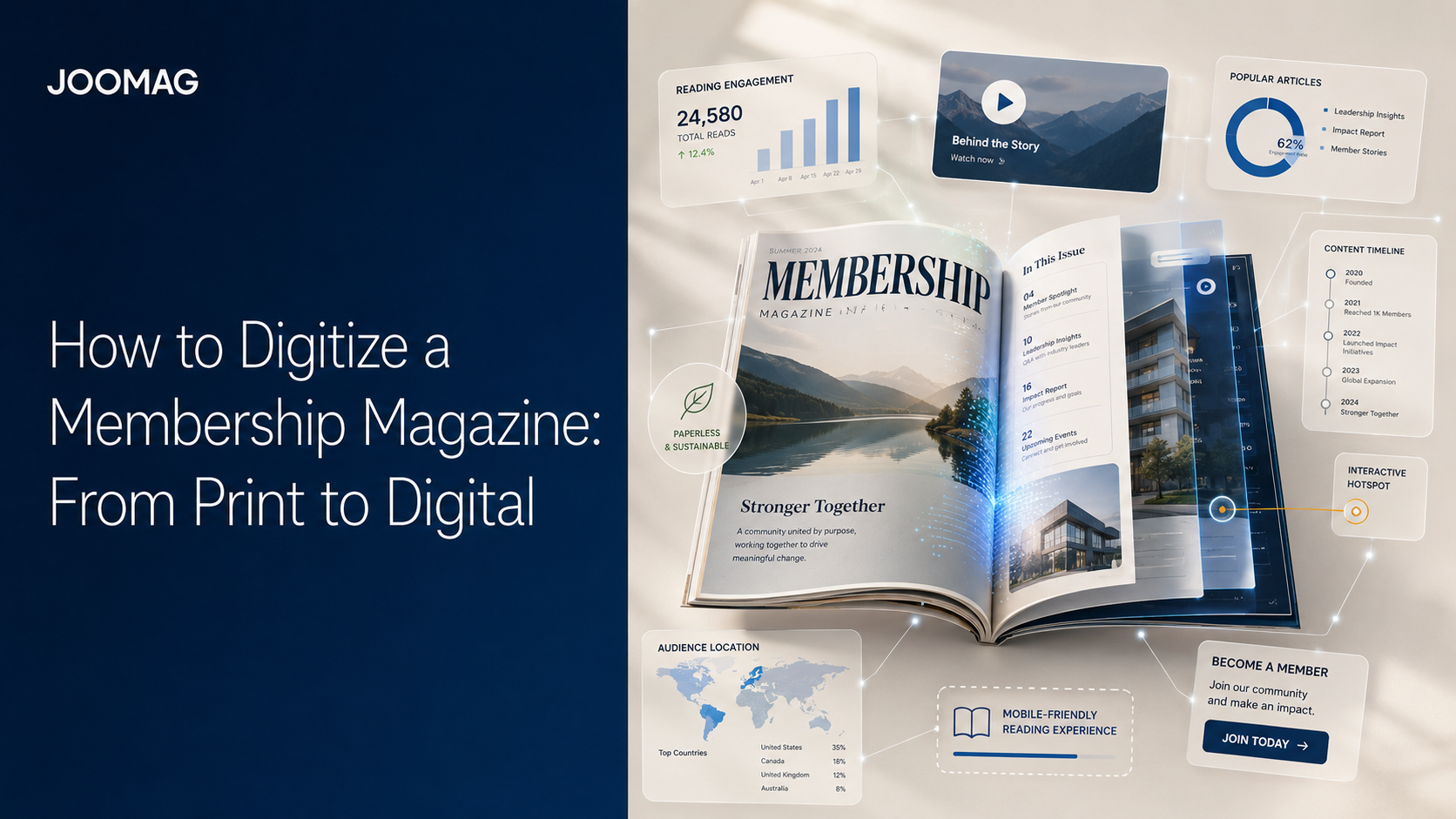
Membership magazines have long helped associations share industry news, member stories, leadership updates, research, events, and sponsor content in one trusted publication.
But print-only publishing creates limitations. Printed magazines are costly to produce and distribute, difficult to update, and almost impossible to measure in detail. Static PDFs reduce distribution costs, but they often create a poor mobile reading experience and provide little insight into what readers actually engage with.
Digitizing a membership magazine does not mean abandoning its identity. The strongest approach preserves the familiar magazine experience while adding interactive features, responsive articles, multichannel distribution, AI-powered content repurposing, and actionable analytics.
This guide explains how associations can move from print or static PDFs to a modern digital membership magazine without losing editorial quality, brand consistency, or member trust.
What Does It Mean to Digitize a Membership Magazine?
Digitizing a membership magazine is more than uploading a PDF to a website.
A complete digital transformation turns the publication into a connected content experience that can be read, shared, searched, measured, updated, and repurposed.
The final setup may include:
- A classic page-turning digital edition
- Responsive HTML articles
- Videos, links, forms, and polls
- Private or member-only access
- Email, website, and social distribution
- AI Video Shorts
- Reader analytics
- Sponsor performance reports
- AI-assisted performance analysis
The goal is to preserve what members already value while removing the limitations of print and static files.
Why Associations Move From Print to Digital
Costs and distribution
Printing, packaging, and postage can consume a large part of a magazine budget, especially when an association serves members across several regions or countries.
A digital edition reduces dependence on physical distribution. Some associations move fully online, while others keep a smaller print run for selected members and make digital the primary format.
Slow updates
Printed content must be finalized well before it reaches readers. If an event date, policy update, contact detail, or link changes after printing, the publication cannot be corrected.
A digital magazine can be updated more easily, allowing associations to fix errors and keep important information current.
Limited reach
A physical magazine reaches the people who receive a copy. A digital edition can also reach prospective members, sponsors, policymakers, partners, and media contacts through email, websites, portals, and social channels.
Limited reader data
Print distribution figures do not show what members actually read. Even a downloaded PDF provides limited insight into which stories attracted attention or which calls to action worked.
Digital analytics make those questions easier to answer.
Print, PDF, or Interactive Digital Magazine?
Associations do not always need to choose one format exclusively.
| Format | Main strengths | Main limitations |
|---|---|---|
| Familiar and premium | High costs, slow updates, little measurement | |
| Static PDF | Easy to create and share | Weak mobile experience, limited analytics |
| Interactive digital edition | Preserves design and adds engagement | Requires a digital workflow |
| Responsive articles | Mobile-friendly, searchable, shareable | Does not fully preserve page design |
| Hybrid model | Supports different preferences | Needs clear planning |
For many associations, the strongest model combines a complete digital edition with responsive articles.
Members who enjoy the traditional layout can browse the full issue. Readers who prefer mobile or search can open individual stories in a web-friendly format.
Step 1: Define the Magazine’s Purpose
Before selecting technology, define what the magazine should achieve.
Typical objectives include:
- Strengthening member engagement
- Demonstrating membership value
- Sharing industry knowledge
- Increasing event participation
- Supporting recruitment
- Improving sponsor value
- Reaching mobile-first audiences
- Collecting member feedback
These objectives influence the format, access model, interactive elements, distribution channels, and metrics.
A magazine focused on engagement may need polls, forms, personalization, and detailed reader analytics. A publication focused on sponsorship revenue may need clickable advertisements, video placements, lead-generation options, and sponsor reports.
Step 2: Audit Existing Content
Most associations already have a valuable content archive.
Review previous print issues, PDFs, recurring sections, popular stories, sponsor content, event reports, research, educational articles, and visual assets.
Identify:
- What members already value
- What should remain unchanged
- What is outdated
- Which stories can become standalone articles
- Which topics can become video content
- Which sections support member value, recruitment, or sponsorship
This ensures the digital version becomes more strategic instead of simply becoming an online copy of the print magazine.
Step 3: Preserve the Classic Magazine Experience
Many associations have invested years in building a recognizable publication. The cover style, photography, departments, and editorial rhythm may be part of the organization’s identity.
Digitization should preserve that value.
A digital publishing platform can keep the original layout while adding:
- Clickable navigation
- Embedded video and audio
- Image galleries
- Polls and surveys
- Event registration links
- Membership renewal buttons
- Interactive sponsor advertisements
The principle is simple: keep the magazine’s editorial character, but remove the limitations of paper.
Step 4: Use AI Article Extraction for Mobile and SEO
A full magazine layout works well for visual storytelling, but it is not always ideal on a smartphone.
Readers may need to zoom and move around the page. Search engines may also find it harder to understand content that exists only inside a static PDF or visual viewer.
AI Article Extraction helps by converting selected stories into responsive HTML articles with clear headings, images, links, metadata, and calls to action.
This supports:
- Better mobile readability
- Improved search visibility
- Easier article sharing
- Direct links from newsletters
- Longer content lifespan
- Better internal linking
- Greater visibility in search and AI-powered answer systems
An editor should still review extracted content for accuracy, structure, tone, and brand consistency.
Step 5: Create a Multichannel Distribution Plan
A digital magazine should not depend on one launch email.
Each issue can support a wider campaign through:
- Member email
- The association website
- Member portals
- LinkedIn and other social channels
- Partner newsletters
- Events
- Branded apps
- Sponsor channels
Promote the full edition at launch, then distribute individual articles and videos over several weeks. This extends the issue’s lifespan and creates more opportunities to reach members.
Different channels can also serve different audience needs.
Existing members may receive access to the complete publication. Prospective members may see selected public articles. Sponsors can promote relevant content through their own channels. Event attendees can receive articles connected to sessions or speakers.
The magazine becomes the central content source, while each channel delivers the format most appropriate for its audience.
Step 6: Turn Articles Into AI Video Shorts
Not every member wants to consume a long article.
AI Video Shorts can turn magazine stories into concise visual assets for social media, email, or the association website.
Useful source material includes:
- Member interviews
- Leadership messages
- Research summaries
- Event highlights
- Educational tips
- Policy updates
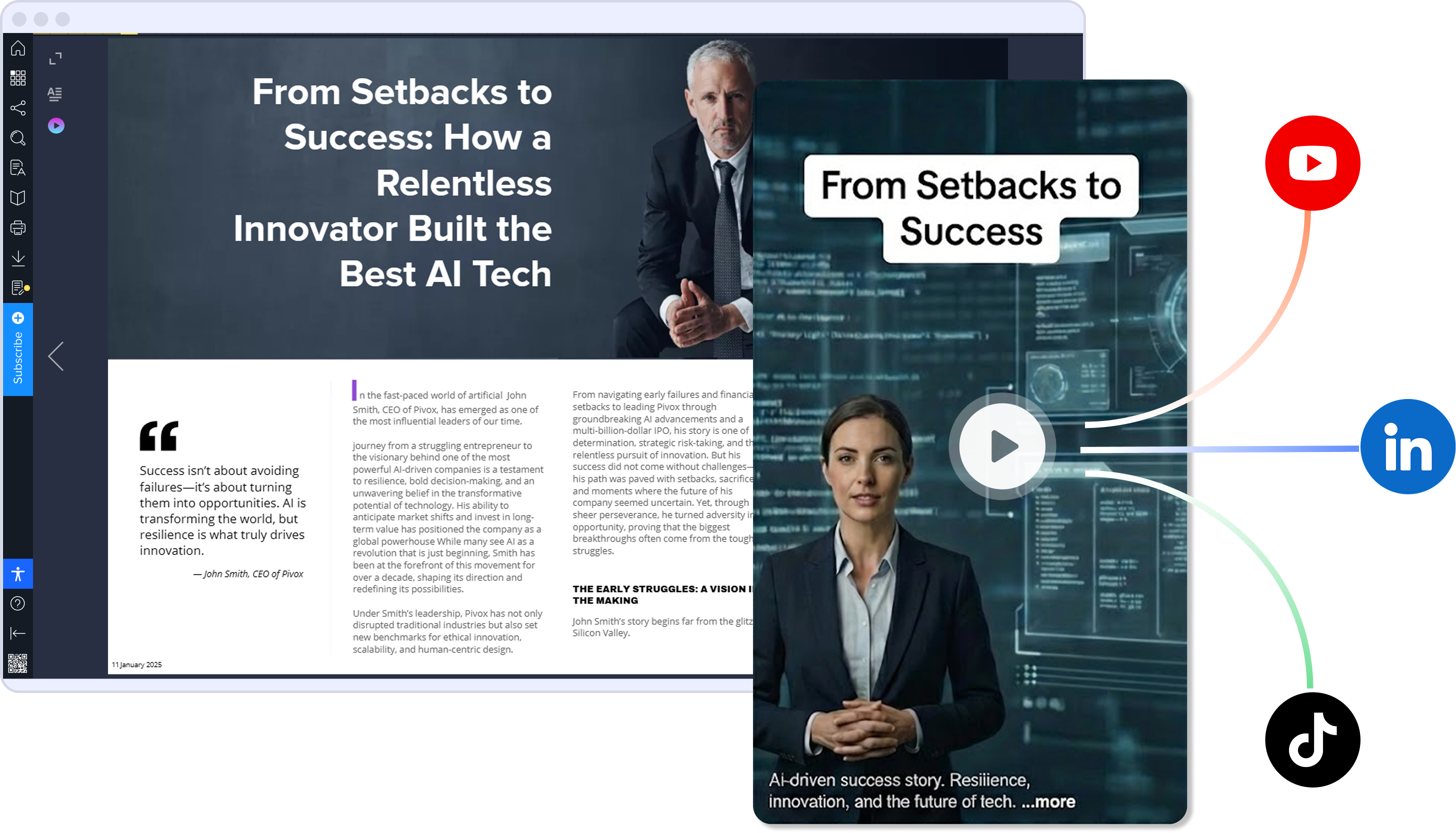
The short video should communicate one valuable idea and direct viewers to the full article or magazine.
For example, a detailed research article might become a 30-second summary of its most important finding. A member interview might become a short quotation video. An event report could become a highlight reel encouraging registration for the next event.
This creates an additional entry point for audiences who may not immediately open a complete magazine or read a long article.
Step 7: Protect Member-Only Content
Some association content should remain exclusive.
A digital strategy can support:
- Public issues
- Public articles with private full editions
- Password-protected publications
- Member-only access
- Segmented content
- SSO through a member portal
- Private board or sponsor reports
Public content can support SEO and recruitment. Private content can strengthen membership value and protect sensitive information.
A hybrid access model often provides the best balance.
An association might publish selected thought-leadership articles publicly while keeping the complete issue, detailed research, training material, or member resources behind a secure login.
This allows the magazine to support visibility and member acquisition without giving away every exclusive benefit.
Step 8: Measure What Members Actually Read
Digital publishing makes it possible to understand how readers use the magazine.
Useful metrics include:
- Publication and article views
- Unique and returning readers
- Reading time
- Pages per session
- Reading depth
- Link and CTA clicks
- Video engagement
- Form submissions
- Device type
- Traffic source
- Engagement by segment
These metrics help answer practical questions:
- Which topics matter most?
- Which article should be expanded?
- Where do readers stop?
- Which calls to action work?
- Which sponsor placement performs best?
- What should be promoted again?
Analytics should influence editorial planning, distribution, and sponsor packages.
For example, if policy articles consistently generate long reading times, the editorial team may expand that section. If members frequently click training links, the association can connect future issues more closely to its educational programs.
Sponsor reporting can also become more meaningful. Instead of showing only circulation numbers, the association can provide information about views, clicks, engagement, and completed actions.
Step 9: Use Joom Agent to Turn Data Into Answers
Analytics dashboards contain valuable information, but interpreting them can take time.
Joom Agent allows teams to ask natural-language questions about publication and content performance.
For example:
- Which articles performed best?
- Which topics generated the longest reading time?
- Where did readers leave the issue?
- Which links received the most clicks?
- How did this edition compare with the previous one?
- Which audience segment was most engaged?
- Which sponsor placement performed best?
- What should we improve next time?
Joom Agent helps editors, communication teams, membership managers, leaders, and sponsor teams move from raw data to clear, actionable answers.
A communications manager could ask Joom Agent to summarize the latest issue for a leadership meeting. A sponsorship manager could ask which advertisement generated the most engagement. An editor could identify articles that deserve additional promotion.
This makes analytics useful even for teams without dedicated data analysts.
Common Mistakes to Avoid
Treating digitization as a PDF upload
A PDF online is not automatically a strong digital experience. Mobile reading, search visibility, interactivity, and analytics should be part of the plan.
Promoting the issue only once
A magazine should support several weeks of content distribution.
Adding interactivity without a goal
Videos, forms, and animations should help readers understand content or take action.
Ignoring accessibility
Readable text, clear structure, alternative text, captions, keyboard navigation, and responsive articles improve access for more members.
Measuring only total views
Associations should also review reading time, article engagement, clicks, completion, and repeat visits.
Replacing editorial judgment with AI
AI can accelerate extraction, repurposing, and analysis, but human review remains essential for accuracy, context, tone, and trust.
How Joomag Supports the Transition
Joomag helps associations transform print magazines and static PDFs into interactive, multichannel, and measurable content experiences.
Associations can use Joomag to:
- Publish the complete magazine in a classic digital format
- Add videos, links, forms, and interactive elements
- Extract responsive articles with AI Article Extraction
- Create AI Video Shorts from magazine stories
- Distribute content through email, websites, embeds, and other channels
- Protect private content and manage access
- Measure reader behavior
- Use Joom Agent to analyze performance and generate reports
This allows one magazine issue to support member engagement, SEO, social media, sponsorship, and analytics.
Conclusion
Digitizing a membership magazine should not mean losing the qualities that made it valuable.
Associations can preserve the trusted magazine format while making content easier to read, share, search, measure, and repurpose.
The strongest model combines:
- A complete interactive digital edition
- Responsive HTML articles
- Multichannel distribution
- AI Video Shorts
- Private member access
- Actionable analytics
- Joom Agent for performance insights
With the right workflow, a membership magazine becomes more than a publication. It becomes a long-term content engine that supports communication, member value, sponsor relationships, and organizational growth.
Ready to transform your membership magazine from print or PDF into an interactive, multichannel content experience? Book a Joomag demo.
FAQ
Should an association stop printing completely?
Not necessarily. Some organizations use a hybrid model, keeping a smaller print edition while making digital the primary format.
Can the existing magazine design be preserved?
Yes. The complete design can remain available in a classic digital edition while selected stories become responsive articles.
How does AI Article Extraction help?
It turns stories into mobile-friendly HTML articles that are easier to share, search, and optimize.
Can magazine articles become videos?
Yes. AI Video Shorts can transform key ideas into short assets for social media, email, and websites.
What is Joom Agent?
Joom Agent is Joomag’s AI-powered analytics assistant. Teams can ask questions about publication and content performance and receive clear, actionable answers.
Can digital magazines remain private?
Yes. Associations can use password protection, restricted access, segmentation, reader identification, or SSO.


