
The popular advice is to upload a PDF, add a page-turn animation, and call the job done. That approach preserves the appearance of print while leaving the business value of digital publishing largely unused. A modern digital magazine platform should turn a publication into a measurable content experience, with responsive delivery, governed production, accessible design, reader identification, and connections to the systems that manage demand and customer relationships.
For B2B teams, the difference is practical. A report, catalog, sales proposal, or internal magazine can guide a reader toward a form, product page, meeting request, or employee resource. It can also reveal which accounts engage, where readers stop, and which content deserves another distribution cycle. The platform is no longer just a viewer. It becomes part of the organization's content operations.
Redefining the Digital Magazine Experience
A flipbook answers a narrow question: can a reader turn digital pages? A B2B content experience must answer harder questions. Can the reader consume the publication comfortably on a phone? Can the marketing team identify an interested account without creating unnecessary friction? Can sales reuse the same content in a proposal, product guide, or follow-up campaign? Can communications teams control access, approvals, versions, and brand standards?
The strongest shift is from issue-based thinking to asset-based thinking. A magazine issue remains an important editorial object, but its articles, charts, forms, videos, product references, and calls to action should also work as reusable components. A single publication might support an awareness campaign, an account-specific nurture stream, a sales conversation, and an internal briefing without forcing each team to recreate the material.
Practical rule: Treat every publication as a structured experience, not as a file with a cover.
That structure starts with the reader journey. A public article can attract search and social discovery. A gated research report can collect business context through a form. A private sales proposal can require authentication and provide account-level access. An internal magazine can distribute leadership messages, policy updates, and employee resources from a controlled workspace. The visual layer matters, but it sits above permissions, metadata, analytics, integrations, and workflow rules.
From passive content to active journeys
Static PDFs make measurement difficult because the organization often sees a download, rather than the behavior that follows. A platform-based publication can connect interaction events to meaningful actions, provided the implementation respects consent and data governance. Useful signals include article views, page progression, clicks on product hotspots, form starts, form completions, and return visits.
That information supports first-party audience intelligence. Marketing can distinguish casual readership from sustained research. ABM teams can compare engagement across target accounts. Sales can see whether a prospect explored technical material before a meeting. Internal communications can identify which resources employees return to and which formats create confusion.
The goal isn't to collect every possible event. Excessive tracking creates noisy dashboards and raises governance questions. The goal is to define a small set of events that map to decisions, then make those events reliable across web embeds, email links, content hubs, and mobile experiences.
Governance belongs in the product
Content operations usually break down at the handoffs. A designer exports a new PDF, a marketer uploads it to a separate service, sales shares an outdated version, and analytics sit in another system. A centralized platform can reduce that fragmentation through role-based permissions, approval paths, locked templates, version control, and standard distribution rules.
Accessibility should be part of the same workflow. Teams need repeatable checks for semantic reading order, keyboard navigation, captions, transcripts, contrast, accessible forms, and downloadable files. A publication isn't accessible merely because its viewer can technically open it. The content itself must remain usable for people with different assistive technologies and reading needs.
This reframing changes the vendor conversation. Ask less about realistic page turns and more about whether the platform can help your organization publish, govern, distribute, identify, and improve content without creating another isolated workflow.
The Shift to Mobile and Omnichannel Readership
Digital readership now spans print, web, tablets, email, social platforms, and mobile devices. In the United States, approximately 123 million adults read a magazine in print, digital, or tablet format during 2023, representing 48% of the population, according to magazine readership and advertising data from ZipDo. Among people aged 18 to 34, digital magazine readership reached 38% in 2023, up from 35% in 2022. Print readership in that group also rose from 27% to 29%, suggesting that digital adoption can expand total reach rather than replace print outright.
The commercial model has shifted with reader behavior. U.S. consumer-magazine advertising revenue reached $22.7 billion in 2023, including $15.3 billion, or 67.4%, from digital advertising and $7.4 billion from print advertising, according to the consumer-magazine advertising figures. For B2B publishers and corporate communications teams, digital distribution is a publishing channel with its own business role. It supports reach, monetization, subscription development, campaign measurement, demand generation, and account-based marketing.
Design for the connected reader
Global distribution reinforces the need to design around mobile behavior. Reported digital magazine subscriptions grew 15% in 2022 to reach 180 million worldwide, while mobile devices accounted for 60% of digital readership in 2023, according to global digital magazine circulation data. Social media accounted for 58% of digital magazine access in 2023, so discovery often begins outside the publisher's owned environment.
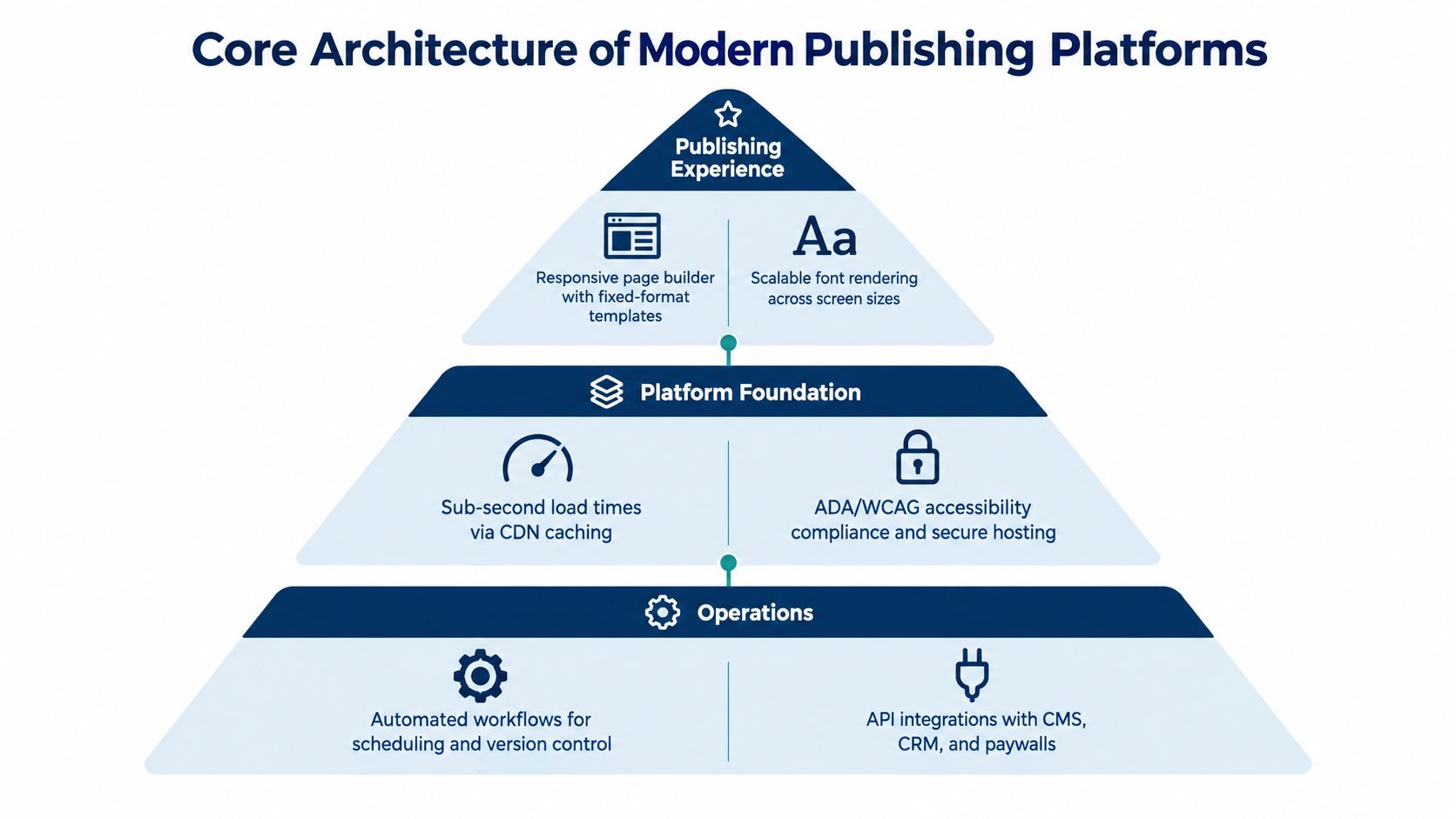
A mobile experience must do more than shrink a desktop page. Use readable typography, appropriately sized images, fast initial rendering, accessible controls, and links that work from email and social posts. Readers may enter through an article page, continue to a related resource, and return through a campaign link. The platform needs to preserve context and attribution across that path.
A mobile reading experience for digital publishing should support both complete-issue reading and single-article consumption. Article-level sharing, deep links, responsive layouts, and reusable content blocks let teams distribute the right content unit for each channel instead of forcing every reader through a full replica.
Omnichannel doesn't mean uncontrolled
Omnichannel publishing becomes difficult when each channel receives a manually edited version. A central content model lets teams maintain one approved source while adapting presentation for websites, email, social distribution, embedded viewers, applications, and internal communications. That structure protects brand consistency and reduces the chance that sales representatives circulate an obsolete document.
Governance should record the content source, audience, permission, edition, and publication status. Teams also need clear distinctions between public, gated, private, and internal material. Without those controls, wider distribution increases operational risk instead of reach. A digital magazine platform earns its place in the content stack when it connects audience experience with reliable ownership, first-party measurement, and controlled reuse.
Core Architecture of Modern Publishing Platforms
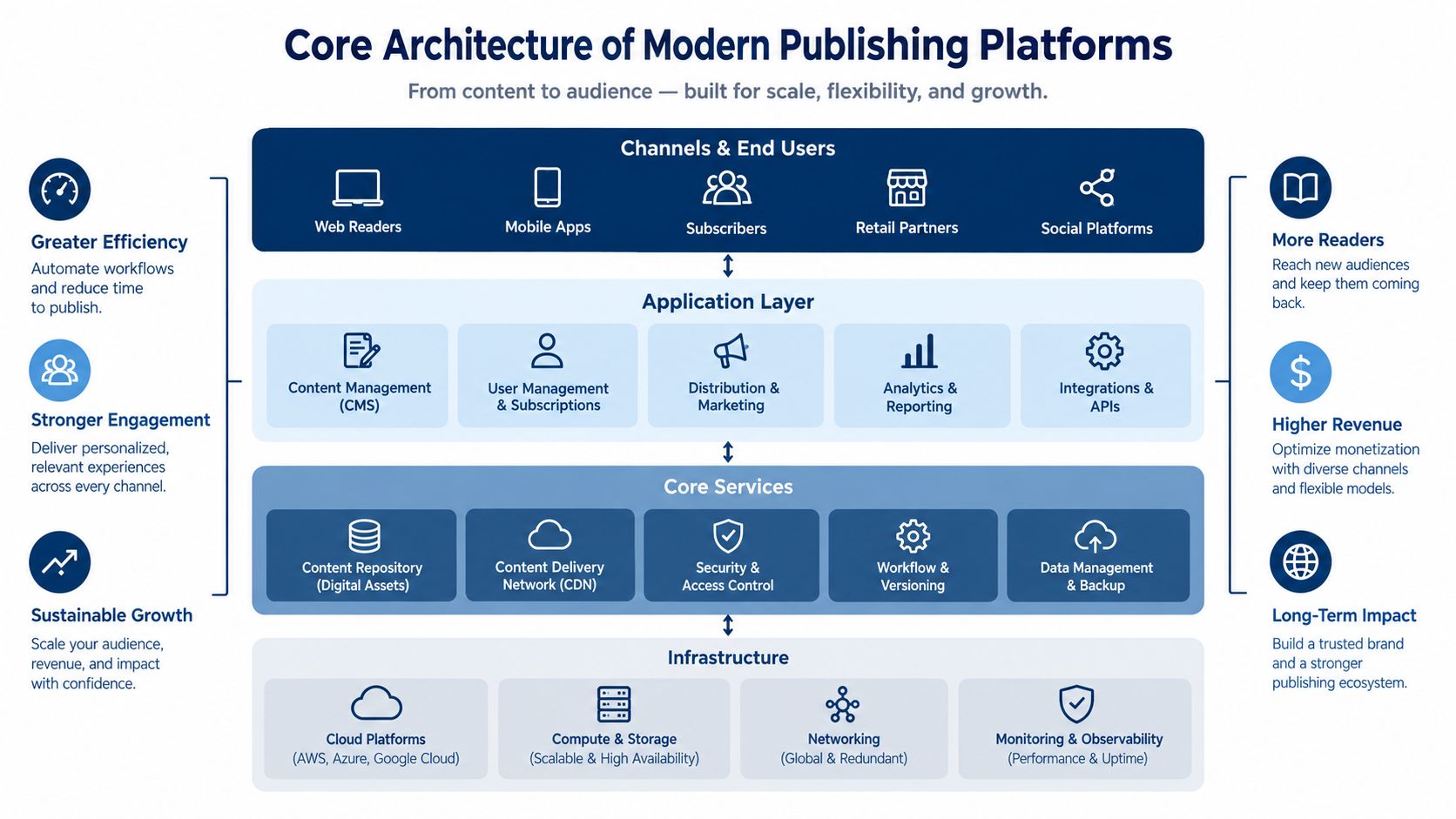
A polished interface can't compensate for slow delivery, inaccessible content, or unreliable data. Enterprise evaluation should begin with the architecture underneath the viewer, then move upward to publishing tools and audience channels.
Start with performance
Google's analysis found that 53% of mobile visits are abandoned when a page takes longer than three seconds to load, as reported in the Google mobile site speed playbook. Magazine pages are especially demanding because they combine high-resolution imagery, custom fonts, embedded media, interactive components, analytics scripts, and sometimes several pages of content in one experience.
A capable platform should handle the first viewport separately from the complete issue. Look for:
- Progressive retrieval: Load the page the reader opens first, then retrieve later pages and media asynchronously.
- Responsive image delivery: Serve properly dimensioned, compressed assets instead of sending desktop-sized images to every phone.
- Caching and content delivery: Keep immutable issue assets close to readers through effective caching infrastructure.
- Script discipline: Defer nonessential embeds and reduce the JavaScript needed for the initial interaction.
- Real-user measurement: Monitor Core Web Vitals and interaction performance across device and connection types.
A full issue shouldn't behave like one monolithic download. Readers need to start consuming content while later assets arrive in the background. Templates should also impose technical budgets for image weight, font files, third-party scripts, and interactive widgets.
Make accessibility a production system
Accessibility fails when it depends on the memory of an individual designer. Governance should build checks into templates, content entry, review, and release. Editors need control over headings, reading order, alternative text, captions, transcripts, contrast, focus states, and forms. The same standards should apply to translated editions, interactive embeds, and legacy PDFs that remain available in an archive.
AI can assist with repetitive work, including draft alternative text or metadata. It can't reliably determine whether a description conveys the right meaning, whether a chart needs a longer explanation, or whether a complex layout has a logical reading order. Human review remains necessary, especially for customer-facing, regulated, or high-consequence communications.
A 2025 academic-publishing survey found that 20% of respondents planned to implement AI for alt-text generation, while 63% identified inefficient workflows as a major problem and 45% cited integration challenges, according to the Trends in Academic Publishing 2025 survey. Those findings point to a broader lesson. Automation creates value when it sits inside an approved workflow with ownership, review criteria, and measurable quality standards.
Govern AI by risk
The safest starting points are usually copy editing, metadata suggestions, summaries, translation drafts, and content classification. Higher-risk uses include factual claims, personalized recommendations, confidential sales material, sensitive employee communications, and automated audience decisions.
Create an AI register that records the use case, input data, reviewer, disclosure requirement, and acceptance criteria. Measure whether automation reduces time to publish, approval revisions, accessibility defects, or production cost. More output isn't the same as better operations.
AI Article Extraction and Content Repurposing
A magazine, report, or catalog takes significant time to produce. AI helps teams extend that investment by turning existing publication content into formats that are easier to read, discover, and share.
With Joomag’s AI Article Extraction, teams can convert individual articles from a PDF into mobile-optimized HTML pages. Each article receives its own URL, allowing marketers to share a specific story through email, social media, or sales outreach. Readers can access the relevant content directly, while the original publication remains available for the complete reading experience.
The same content can also become short-form video. Joomag’s AI Shorts transforms publication articles into videos with AI-generated scripts, voiceovers, visuals, and background music. Teams can customize fonts, voice, and brand colors, then review the output before sharing it.
For example, a research report can become a collection of standalone articles, with selected insights repurposed into short videos for LinkedIn, Instagram Reels, or YouTube Shorts. Those videos can introduce a compelling finding and encourage viewers to explore the full article or report.
This gives each publication a longer useful life and more opportunities to reach its audience, while reducing the manual work required to produce additional formats.
Strategic Use Cases Across the Enterprise
A single platform becomes more valuable when different teams use the same governed foundation for different jobs. The publication format may look similar, but the audience, access model, conversion path, and success metric change by department.
Demand generation and ABM
A marketing team might build an industry briefing with editorial pages, embedded video, a research form, and links to related resources. Public sections can establish expertise, while premium material is available after the reader provides business context. The team can then use engagement signals to refine nurture paths and prioritize accounts that show sustained interest.
For account-based marketing, the experience should support account-specific messaging without producing uncontrolled one-off files. A reusable template can preserve brand rules while allowing selected modules to change by industry, buying stage, or account group. Joomag offers account-based marketing capabilities that connect interactive content with personalization, reader identification, and campaign workflows.
The operational test is whether the publication helps sales and marketing agree on what counts as meaningful engagement. A page view alone may be weak evidence. A combination of identified readership, repeated visits, interaction with a relevant product section, and a completed action provides a stronger basis for follow-up.
Sales enablement
Sales teams often need materials that change faster than formal editorial cycles. An interactive proposal can include product comparisons, customer-specific sections, technical diagrams, video demonstrations, and a meeting request. A catalog can link product references to landing pages or forms instead of forcing the buyer to search manually.
The risk is version sprawl. Sales representatives may download, edit, and circulate files with no reliable expiration process. Central permissions, version status, and access controls help the content team retire obsolete material and protect confidential pricing or account information.
The best workflow doesn't ask salespeople to become designers. It gives them approved modules, controlled personalization, and a clear route for requesting exceptions.
Internal communications and HR
Corporate communications teams can use a magazine-style experience for leadership updates, employee resources, policy explainers, and organizational reports. Employees may access the content from an email, intranet, or mobile device, so the platform needs reliable authentication, accessible presentation, and clear navigation.
Internal publications also benefit from feedback tools. A short response form or survey can reveal whether employees understood a policy or found a resource useful. That feedback is more actionable than a distribution report that only confirms delivery.
The shared platform model reduces duplication. Marketing, sales, HR, and communications can maintain separate workspaces and permissions while using common templates, accessibility controls, analytics conventions, and approval rules.
Evaluating Platform Vendors and Capabilities
Vendor selection gets clearer when teams compare operating models rather than feature counts. A basic converter may be perfectly adequate for a one-off public brochure. It becomes a poor fit when the organization needs account identification, controlled access, CRM synchronization, reusable modules, and audit-ready approvals.
| Platform Type | Best For | Analytics Depth | CRM Integration |
|---|---|---|---|
| PDF converter or basic flipbook | Simple replicas and low-complexity distribution | Usually limited to views, opens, or broad engagement signals | Often limited or handled through external tools |
| Design-led editorial platform | Branded magazines, catalogs, and visually controlled publications | Often stronger at content and interaction reporting than basic viewers | Varies widely, verify native connections and API support |
| B2B content experience platform | Demand generation, ABM, sales enablement, and internal communications | Reader-level, content-level, and journey-oriented reporting when configured correctly | Expected to support forms, CRM, marketing automation, and identity workflows |
Questions that expose the real trade-offs
Ask vendors to demonstrate a complete workflow, not just a finished issue. Provide a representative PDF, a complex chart, a video, a gated form, a private page, and an outdated version that must be retired. Watch how the platform handles accessibility, approvals, analytics, and distribution under those conditions.
Use these evaluation questions:
- Mobile delivery: Does the platform reflow content, or does it merely place a print page inside a viewer?
- Performance control: Can teams manage image loading, embeds, caching, and progressive retrieval?
- Governance: Are permissions, approval stages, version history, and brand controls built into the workflow?
- Accessibility: Can editors manage semantic structure, alternative text, captions, keyboard access, and accessible forms?
- Audience data: Can the platform distinguish anonymous engagement from identified readership while respecting consent?
- Integration: Does it connect to the CRM, marketing automation system, CMS, identity provider, and analytics stack?
- Reuse: Can a team repurpose an article or module without recreating the entire publication?
- Exit and portability: What happens to URLs, data, assets, and archives if the organization changes vendors?
Calculate the hidden cost
A low subscription price doesn't guarantee a low operating cost. Teams should account for manual PDF exports, repeated data entry, accessibility remediation, campaign tagging, fragmented reporting, support requests, and the time salespeople spend searching for current assets.
A platform that centralizes those tasks may cost more than a viewer, but it can reduce the number of systems involved in every publication. The right comparison is not license price against license price. It's the total effort required to produce, approve, distribute, measure, and maintain a trustworthy content experience.
Measuring Engagement and Business Impact
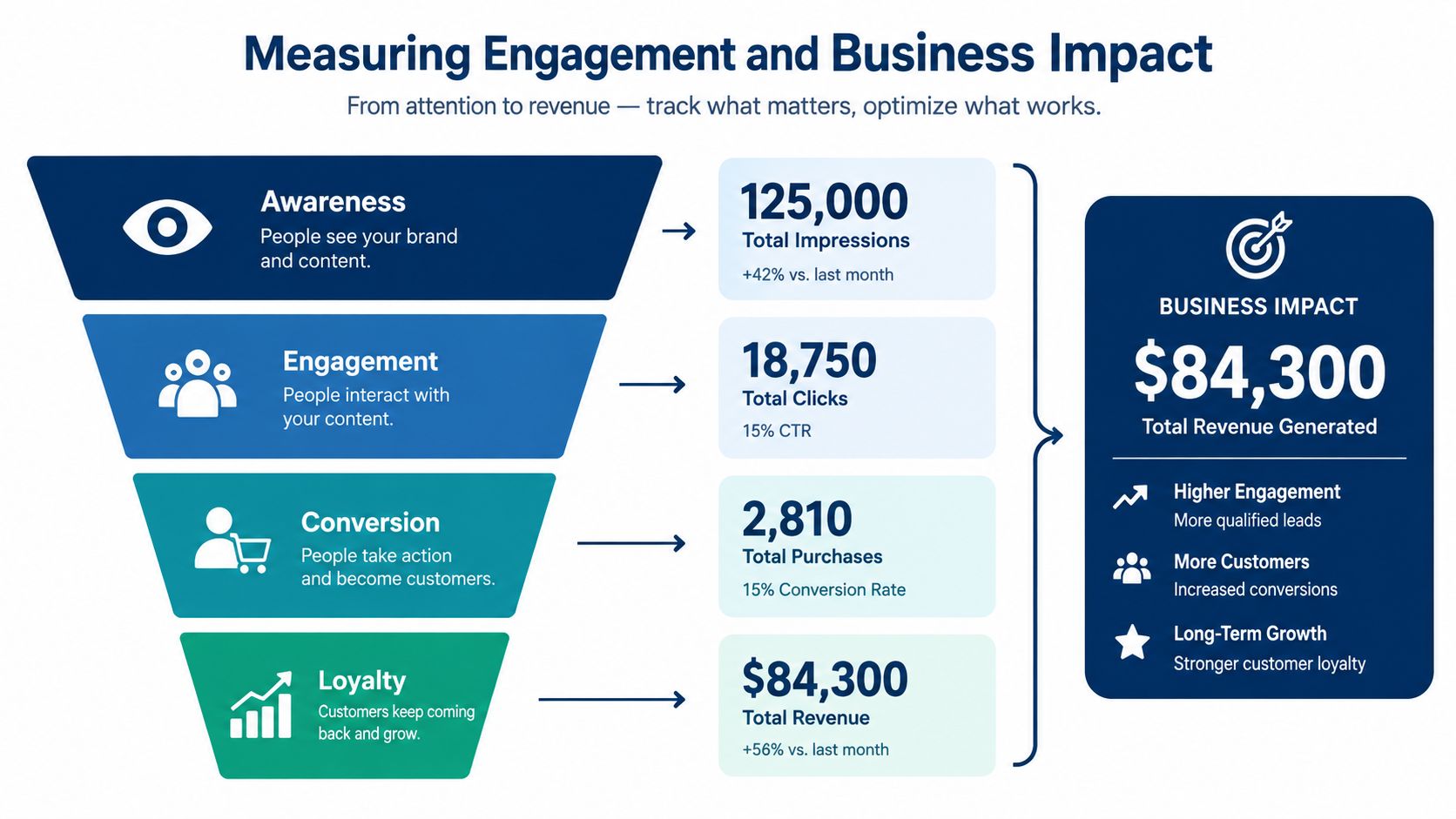
A publication dashboard shouldn't stop at opens. It should connect technical conditions to reader behavior, then connect reader behavior to an action the business values.
Start with the journey in layers. The first layer covers delivery, including time to first content, page-render completion, interaction latency, and errors. The second covers consumption, including article views, progression, completion, return visits, and engagement with media. The third covers identity and action, including identified-reader rates, form completion, meeting requests, qualified actions, and conversion signals.
Connect latency to outcomes
A peer-reviewed mobile-web study reports that adding 1.5 seconds to users' normal response time reduced revenue per user by 4.3%, as described in the mobile-web response-time study. The finding matters for digital magazines because delay can occur beyond the initial load. Page turns, search, personalization, authentication, form submission, and recommendation modules can each interrupt the reading journey.
Instrument those transactions independently. A reader may reach an important call to action but abandon the experience because a form blocks the next page. A sales proposal may be opened successfully but fail to produce a response because a video delays the relevant section. Technical reporting becomes useful when it helps identify those points of business friction.
Build a decision dashboard
A practical dashboard can group measures by decision:
- Distribution: Which channels bring qualified readers, and which links produce low-quality traffic?
- Consumption: Which sections hold attention, and where do readers stop?
- Identification: Which audiences choose to authenticate or complete a form?
- Action: Which interactions lead to a request, download, meeting, or sales handoff?
- Operations: How long does production take, how many approval revisions occur, and where do accessibility defects appear?
- Performance: Which devices, regions, and connection types experience slow or failed interactions?
The dashboard should assign an owner to each metric. Marketing may own qualified actions, editorial may own completion and return behavior, IT may own latency and errors, and communications may own employee feedback. Shared definitions prevent teams from optimizing contradictory outcomes.
A digital publishing analytics solution should support that chain from content performance to audience insight, but the platform can't define business value for you. Decide what action matters before configuring events, then test whether the data changes a real decision.
Building Your Content Operations Roadmap
Adopt the platform as a workflow transformation, not as a replacement for a PDF upload tool. Begin by inventorying existing publications, owners, audiences, access rules, approval stages, and distribution channels. Classify the archive by migration priority, accessibility risk, business value, and likelihood of reuse.
Next, create a small template system. Lock brand elements that shouldn't drift, define flexible modules for campaign and sales needs, and establish naming, versioning, and retirement rules. Train marketers, sales contributors, HR partners, and editors to use approved components without making every change dependent on a designer.
Then connect the platform to the systems that already govern audience and action. Map forms and reader identity to the CRM or marketing automation process, define consent requirements, and set an event taxonomy for engagement. Test mobile performance, accessibility, permissions, and analytics with real content before migrating the full archive.
Finally, publish a review cadence. Examine production time, approval friction, accessibility defects, reader behavior, return visits, and qualified actions. Improve templates and distribution based on evidence, rather than adding interactive features just because they are available.
A successful implementation leaves the organization with fewer disconnected files and more dependable content intelligence. The result is a publishing operation that can serve demand generation, ABM, sales enablement, and internal communications from one governed foundation.
Joomag helps organizations create and distribute mobile-optimized magazines, catalogs, proposals, reports, and other interactive content with governance, access controls, first-party audience data, and analytics. Visit Joomag to evaluate how a centralized digital publishing workflow could support your B2B content operations.