The most repeated advice on gated vs ungated content is tidy, and it is the wrong scorecard. Gate the "premium" file, leave the blog open, and call the winner by form fills. That rule treats a magazine, a research report, a catalog, and a client proposal as if they were the same asset, and it ignores what happens after someone is identified.
A digital publication can be fully public, stopped by a form, locked with a password, or tied to a verified account. Each choice changes who can find the issue, who can be named, and whether a sales, membership, or communications team can act on the read. A gate can raise contact volume while cutting citations, shares, and later revenue. An open issue can look like a lead-gen failure and still move pipeline.
Judge the access model by the downstream commercial outcome and by what search and AI systems can still see. Form volume is the weakest of those measures.
Which Access Model Fits Each Goal
Pick the model from the goal, not from a house rule that every PDF gets a form. The matrix below rates fully public, form-gated, password-protected, and authenticated access against the six jobs a publication usually has.
| Goal | Fully public | Form-gated | Password-protected | Authenticated |
|---|---|---|---|---|
| Reach and SEO | Best | Poor | Poor | Poor |
| Lead generation | Poor | Best | Fair | Good |
| Subscriber acquisition | Fair | Best | Poor | Good |
| Member-only content | Poor | Fair | Fair | Best |
| Internal communications | Poor | Poor | Fair | Best |
| Confidential materials | Poor | Poor | Good | Best |
Three cells settle most budgets. Reach and SEO is Best when the issue is fully public, because search and answer engines need pages they can read. A form, a password, and a sign-in all rate Poor on that row. They shrink the set of people and systems that ever see the issue.
Lead generation and subscriber acquisition are Best behind a form. Public access is Poor for leads, since it creates no contact record, and only Fair for subscriptions, because an open issue can still carry a subscribe offer. A shared password is a weak way to build a list. Authentication is Good for both once a reader will create an account, but it asks for more than an email.
Member-only content, internal communications, and confidential materials are Best when access is authenticated. A public file is Poor in every one of those rows. A password is only Fair for members and staff, and Good for a small confidential send where you can rotate the secret. It is not a substitute for revoking one person.
The grid misleads if you force a whole library into one cell. A short magazine issue can stay public and still feed a subscription offer on the last pages. A long research report can be gated for leads while its summary stays public.
Read down the goal row, take the Best cell, then check every Poor cell beside it. Those cells are the risk you accept: lost identity, lost reach, or lost control.
How the Four Access Models Differ
Gated is not one control. It can mean a form, a password, or a full account, and those controls do not identify readers, travel, or get revoked in the same way.
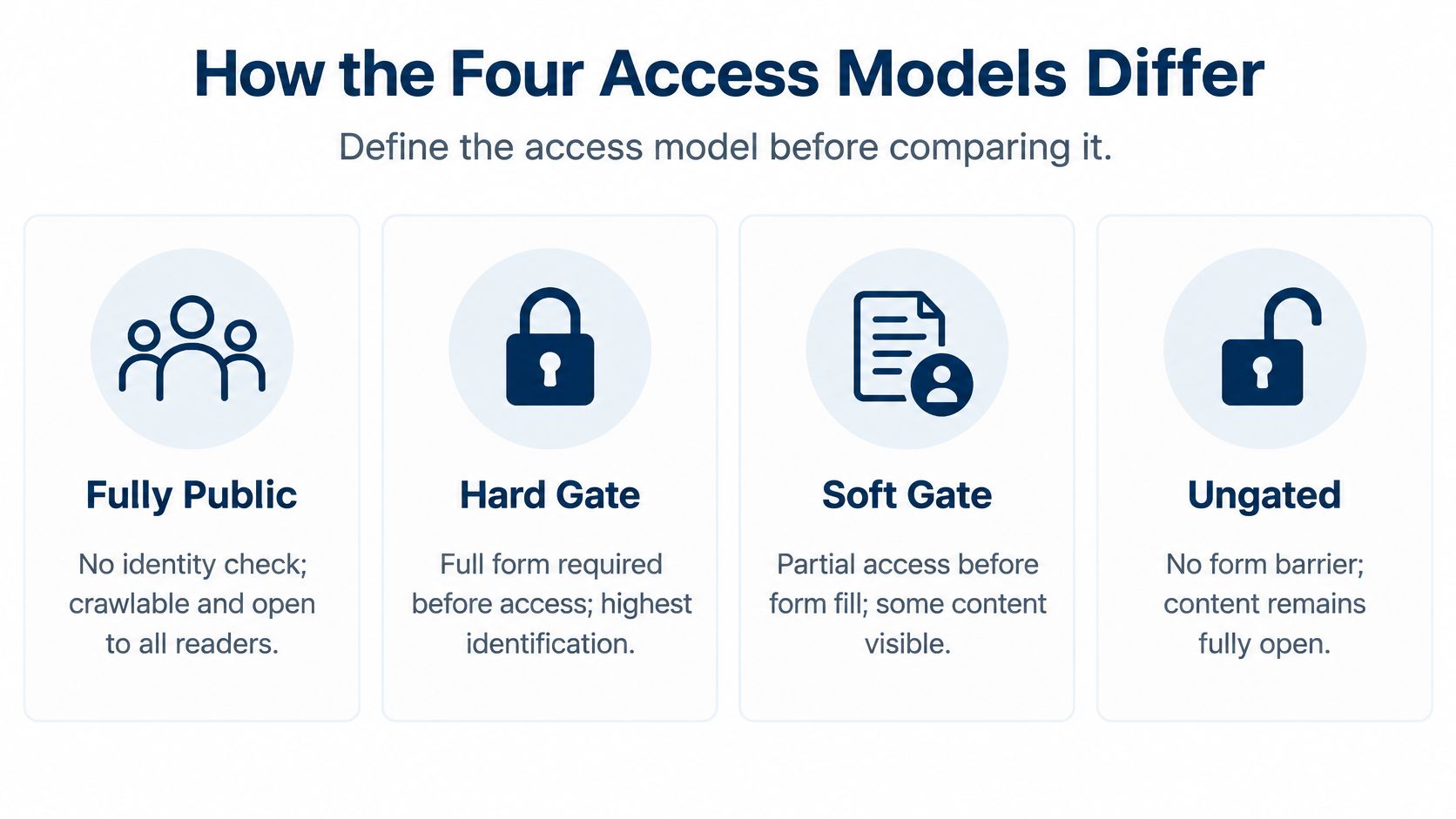
Fully public publications need no identity check. A consumer magazine, a catalog, or a public report can be crawled, forwarded, and read without a stop. Reach is the highest of the four. The cost shows up after the share. You cannot recall a file that has already been forwarded, and you cannot see who opened it unless the reader volunteers a subscription or a comment.
Email or form-gated publications ask for data before the full issue opens. That submission is an identification point, which is why the model fits research reports, e-books, and resource libraries used for leads or new subscribers. Reach stays high until the form. Friction is the cost. People who will not complete it never enter the count, and you have granted a download rather than a managed permission.
Password-protected publications use one shared password or a password issued to each recipient. Setup is simple, which suits a client proposal or a limited-distribution report. Reach is low by design. A shared password is a weak identity. You cannot tell which person on a team opened the file, and changing the password locks everyone out, not one leaver.
Authenticated or private publications tie access to a verified account, a membership, or an organization permission. That is the right home for a member magazine, a staff briefing, and a confidential file. Administrators can revoke one user, segment a group, and audit who had access. Sign-in is the highest barrier to reach, so this model should not carry a campaign whose job is discovery.
| Access model | Reader identified | Reach | Revoke or audit access | Typical publications |
|---|---|---|---|---|
| Fully public | No | Highest | No, once shared it cannot be recalled | Consumer magazines, catalogs, public reports |
| Email or form-gated | Yes, by form submission | High before the gate | Limited; access is granted, not managed | Research reports, e-books, resource libraries |
| Password-protected | Only with individual passwords | Low | Yes, by changing the password; shared passwords are hard to revoke selectively | Client proposals, limited-distribution reports |
| Authenticated or private | Yes, through a verified account | Lowest | Yes, per user and per group | Member magazines, staff briefings, confidential files |
Privacy settings, authentication, permissions, and forms can sit on different issues, or on different parts of the same issue. A library rarely needs one model for every file.
Reach Versus Identification and What You Trade Away
Every gate swaps readers for names. Open the file and you keep the crowd. Close it and you keep a list.
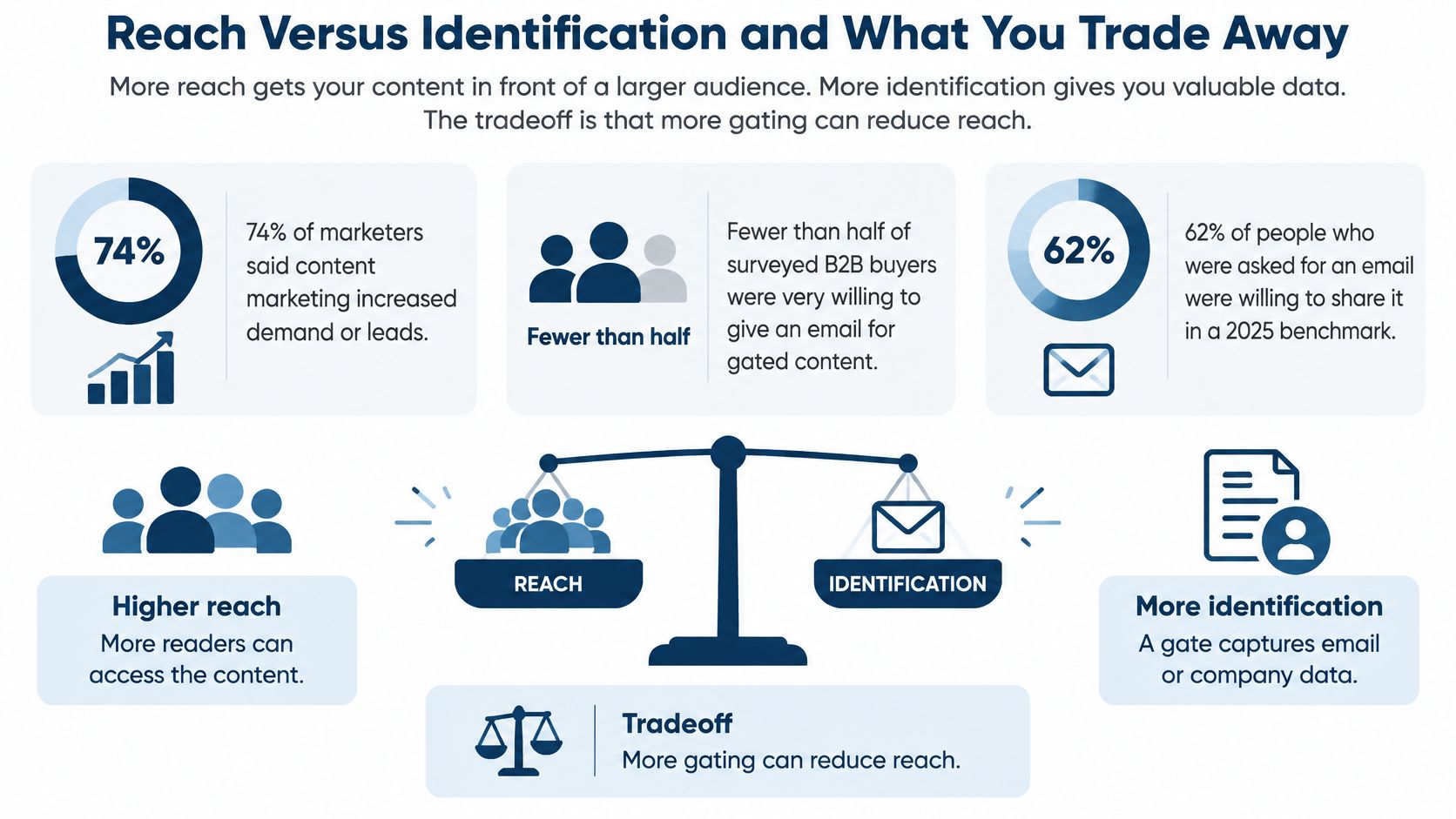
In the Content Marketing Institute's 2025 B2B benchmarks, 74% of marketers said content marketing helped generate demand or leads, 62% said it nurtured subscribers, audiences, or leads, and 49% said it helped generate sales or revenue. Those figures do not prove a gate caused the result. They show what identified audiences are already used for: demand, nurture, and revenue.
A report with two doors
Say one report could reach 10,000 readers if you leave it open. Shares, search visits, and anonymous reads all count. You still have no contact record unless someone subscribes or sends feedback on their own. Put the same report behind a short form and the people who finish it become identified leads. Their reading can attach to a contact record. Joomag identifies readers using first-party data or forms, which is the point of that exchange. Everyone who refuses the form drops out of the 10,000.
The drop is largest when the audience is broad and does not know the brand. It is smallest when the readers already sit in target accounts and expect a next step. A catalog meant to be passed around pays a heavy price for a form. A benchmark aimed at evaluators pays a smaller one.
Use open access when audience growth and SEO dominate. Use a form when qualified leads or subscriptions justify losing some reach. Reserve stronger authentication for members, employees, clients, and confidential audiences.
What Recent Evidence Shows and Its Limits
A lot of research ends before a company form exists. A 2024 SparkToro study, covered by Search Engine Land and based on Datos clickstream data from September 2022 to May 2024, found that 58.5% of Google searches in the United States and 59.7% in the European Union ended without a click. An open publication page has to earn attention in that environment. A gate never sees the searches that stop on the results page.
Demand for gated assets has not collapsed. NetLine reported a 14.3% year-over-year increase in gated B2B content requests in 2024, from 6.2 million first-party content registrations.
Willingness is softer than that request growth.
- Very willing: Scribewise's 2024 survey of 204 B2B buyers and budget owners found that 48% were very willing to provide their information in exchange for content.
- Somewhat likely: Marketsplash's recap of Demand Gen Report's 2024 Content Preferences survey found that 83% of B2B buyers were at least somewhat likely to complete a form for high-value gated content.
The gap is mostly the wording of the question. Treat the higher figure as a ceiling for a strong offer, not as a forecast for every PDF.
Two circulating benchmarks should not be quoted as fact. Contentmation flags a 5% to 15% conversion range for gated landing pages, and a claim of 20 to 40 times more views for ungated content, as marketing secondary sources rather than neutral primary research. Offer type, audience, traffic source, form length, brand trust, and buying stage still move the result. One blended conversion rate hides that spread.
How Gates Affect Discovery and How to Build a Hybrid Preview
Ungated HTML can be crawled. It can pick up organic demand, links, and citations in AI answers. A login stops Google from reading the protected material, so that material stays out of results. robots.txt does not control indexing. A noindex directive or a login does.
One 2025 analysis of gated content reported that gated content was cited 64% less often in AI-generated answers than open content. A case study in the same write-up found that ungating 16 e-books increased AI citation share approximately fourfold and branded organic search by 38%. Marketing-qualified leads fell 71%, opportunities stayed flat, and closed-won deals rose 4%.
Score that policy on the later numbers, not on the lead count. Ungating can shrink conventional MQLs and still improve closed revenue. Scoring only form conversions rewards low-intent contacts and punishes pages that other systems can cite.
What has to stay visible
The split is not "gate the asset or don't." It is which portions stay crawlable and which portions justify a name. Key findings, sample pages, data definitions, and short excerpts can stay in the index. The full report, a customized recommendation, the downloadable file, or an implementation template can sit behind identification.
Google's paywalled content documentation says a gate does not automatically remove a publication from discovery, but restricted material you want indexed has to be crawlable and labeled. For subscription or registration content, add structured data with isAccessibleForFree set to false and a hasPart element that points at the gated section with a CSS selector. Googlebot, and Googlebot-News where the issue is news, must be able to fetch the page. A login, a robots.txt block, or noindex can keep it out. The label also has to match the restriction. Google treats an accurate declaration as a paywall and a mismatch as cloaking.
- Publish a public landing page with the title, abstract, metadata, and three to five key findings.
- Add crawlable previews, such as sample chapters, the methodology, or the key charts.
- Gate the full issue, the PDF, or the viewer with an email form, a subscription, or a login.
- Add that structured data on the indexed page, with the gated block named in hasPart.
- Confirm Googlebot, and Googlebot-News if it applies, can reach the page.
- Check that the sections you mark as restricted are the sections a reader cannot open for free.
The same pattern fits a magazine, a research report, and a resource library. The open layer is the abstract and a few pages. The closed layer is the full issue. Joomag's Lite/Scale plan includes hard-gating, soft-gating, and metered-gating, so a reader can see a preview, a set number of pages, or nothing until the form. That issue can be a standalone viewer, a content hub, a website embed, or a native mobile app, including through digital publication delivery.
The miss that kills discovery is a landing page that promises the full report and shows nothing a crawler can quote. A title and a form is not a preview.
Ask Only for the Data a Gate Earns

Fewer than half of surveyed B2B buyers were "very willing" to provide an email for gated content, and a separate 2025 benchmark reported that only 62% of people who completed a form consumed the requested asset, as discussed by White Hat SEO. A high completion rate can mean curiosity, inaccurate details, or a reader who felt forced. It does not prove buying intent.
Ask only for the data the gate has earned.
Collect it in three layers, and stop when you have enough to do the next job.
Anonymous read. Useful editorial pages stay open. No form, no cookie-wall theater.
A light signal. Before any personalization, ask for a role or a preference. That is enough to change a table of contents. It is not a business card.
Contact details for a high-intent action. Company, email, and role wait until a benchmark download, a sales workspace, or a personalized recommendation.
State why each field is there, in a line next to the box. Offer a non-form route when one exists, such as a call the reader books or an account they already have. Keep marketing consent separate from access permission. A reader should be able to open the issue without joining a newsletter.
Score the gate on verified consumption, return visits, account penetration, unsubscribe rate, and opportunity progression. Submissions are the weakest of those numbers, because a name in the CRM can be a person who never opened page two.
Say a publisher asks for a name and an email on the first issue, then asks for company and role only when that reader requests a benchmark. Data capture forms can take the light signal first and the business fields later, instead of demanding the full record on page one.
Test One Publication Both Ways Before You Commit
Don't convert the library on a hunch. Pick one publication and run both versions before you lock the policy.
A synthesis of a 144-day split test is the clearest comparative evidence on hand, and it is still not a universal law. Ungating produced 62% more case-study downloads and 15% more downloads for guides and research reports. Case-study downloaders who completed a form generated 13% more demo requests than people who received the asset without a form. Open access lifted top-of-funnel volume. The form lined up with more demo intent on that asset type. Follow-up quality and the kind of file can flip the result, so one test is a start, not proof for every issue in the library.
Match the offer. Use the same creative, the same distribution, and the same call-to-action placement.
Split the traffic at random. One version asks for the form. One does not.
Read both ends of the funnel. Cost per engaged reader, completion rate, qualified-account rate, demo rate, pipeline per 1,000 visitors, and revenue attribution.
Break the blend. Compare new and returning visitors, target-account status, geography, device, and traffic source. One conversion rate will hide the only segment that mattered.
Joomag's Granular Data tracks user actions, content consumption, and engagement metrics, which is how you see what readers do after each version. Pair it with digital publishing analytics so the open version and the gated version are not collapsed into a single rate.
A fair test variant is a two-stage journey: free, mobile-friendly HTML or a viewer for discovery, then an optional gate for a recommendation, a source file, an event, or a consultation. Keep the form to the fields you need for routing or personalization, and use explicit consent language.
Write the decision rule before you launch. Keep the issue public if the reach gain outweighs any drop in qualified outcomes. Gate it if demo rate and pipeline per visitor rise.
Joomag lets you publish magazines, reports, catalogs, and resource libraries with public access, forms, passwords, or authenticated sign-in, and to measure what readers do after each choice. Hard, soft, and metered gates can sit on the full issue while a preview stays open for search. See how that works on Joomag.