Digital circulation can grow sharply while print still supplies most copies. At Immediate Media, digital magazine circulation increased 49.6% to 129,796 in 2024, while print declined 11% to 726,030, according to ABC figures reported by The Media Leader. That's a more useful starting point for the digital magazine vs print magazine debate than assuming one format replaces the other.
For publishers, associations, corporate communications teams and brands, the decision is about which reading experience serves which audience, at a sustainable operating cost. Print, downloadable PDFs, fixed-layout viewers and responsive articles each solve different problems. The right comparison considers the whole publishing workflow, not just paper versus screens.
Print and Digital Formats Compared at a Glance
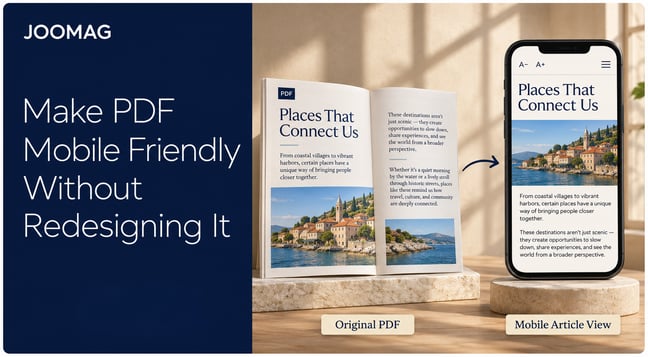
A downloadable PDF retains the source document, while a fixed-layout digital viewer presents designed pages with options for interactive overlays. Responsive HTML articles reflow text and images to fit the screen, making them a distinct reading experience rather than another way to display the same spread.
Print and digital formats compared on nine criteria
| Criterion | Downloadable PDF | Fixed-layout digital viewer | Responsive HTML articles | |
|---|---|---|---|---|
| Reading experience | Physical, tactile pages without screen glare | Designed pages; navigation follows the PDF viewer | Designed pages with interactive overlays on a page-sized canvas | Text and images reflow to fit the screen |
| Mobile usability | Read without a device | Device viewer controls usability; small text may need zooming | Page-sized canvas may require navigation on small screens | Generally best suited to narrow mobile displays |
| Accessibility | Fixed type size; large-print editions require separate production | File tagging, reading order and viewer support determine access | Viewer features and content construction determine access | Semantic structure, alternative text and keyboard support determine access |
| Production cost | Print run, paper, printing, finishing and freight | Low incremental preparation cost once an approved design exists | Reuses approved design; adds platform and interactive setup costs | Reuses article content; requires markup and editorial review |
| Lead time | Production schedule plus shipping | Fast after file approval | Fast after approval, conversion and testing | Fast, with conversion and review time |
| Updates after publishing | Distributed copies can't change; replacement requires reprinting | Publish and distribute a new file version | Edit and republish supported content | Edit the article directly |
| Distribution | Mail, retail, events and handouts | Email, download links and website pages | Content hubs, website embeds and native apps | Website pages, RSS feeds and configured syndication |
| Measurement | QR codes, personalized URLs, coupon codes and surveys | Downloads and tracked link clicks; viewer delivery can add behavioral measurement | Page-level behavior and identified readers where configured | Page views, scroll depth and interactions with suitable analytics |
| Monetization | Paid circulation and print advertising | Sales or gated downloads through supporting systems | Subscriptions, individual issues and digital advertising | Advertising, sponsored articles and syndication |
Device choice matters alongside format. In 2015, mobile visitors exceeded desktop visitors by at least 10% at 44 of the 50 largest U.S. newspapers, while desktop users generally spent more time per visit, according to Pew Research Center's State of the News Media report. That historical newspaper finding isn't a magazine forecast, but it illustrates why mobile reach and sustained reading shouldn't be treated as interchangeable.
Practical rule: Use this table as a scorecard, not a ranking. Mark the criteria that matter most to your audience, budget and approved source files.
An advertiser-led title may prioritize page presentation. An employee publication may prioritize accessible reading and timely corrections. Neither priority makes the other wrong.
Who Reads Each Format and How Circulation Shifts
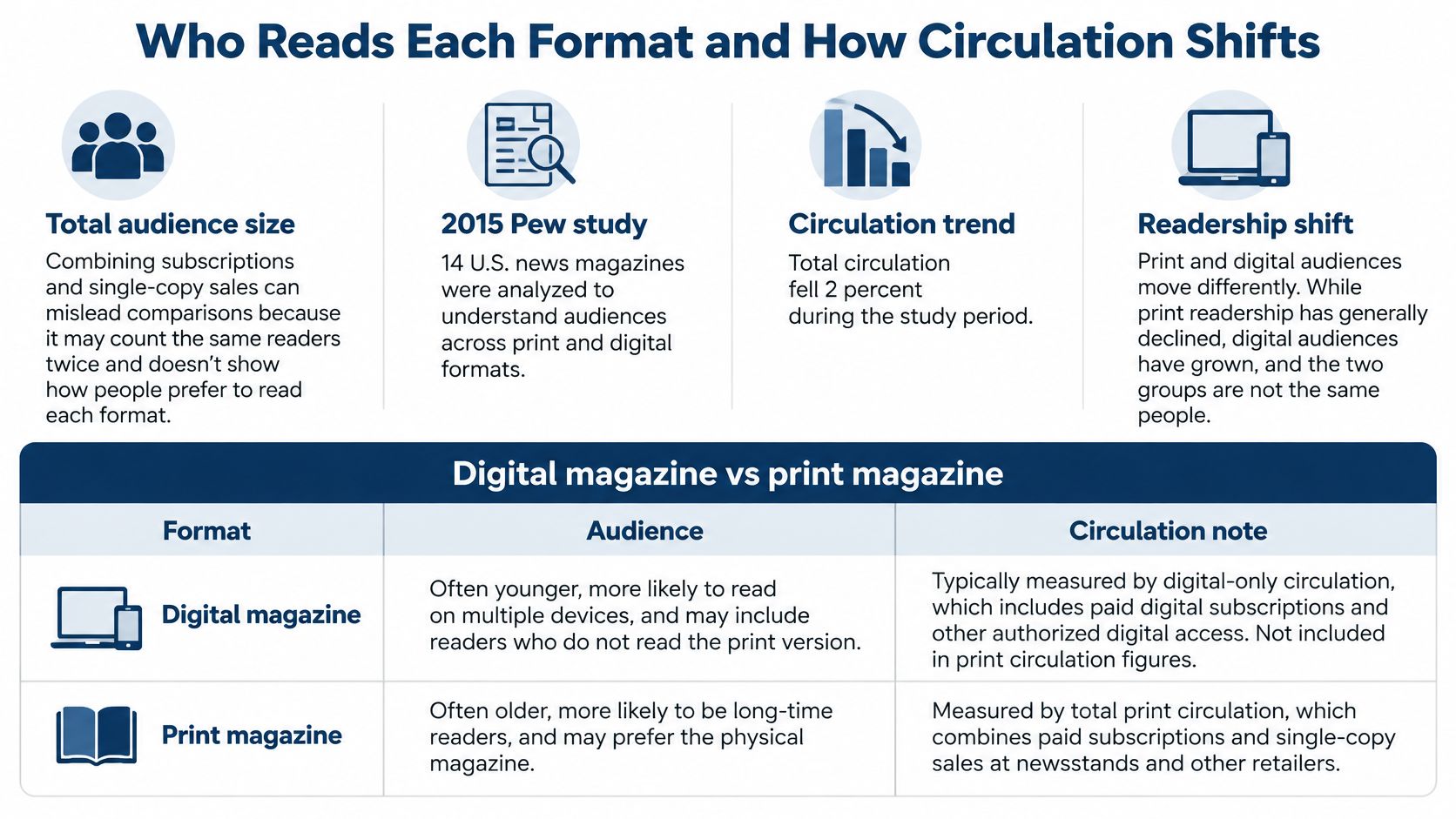
Across 14 U.S. news magazines in 2015, total circulation fell 2% to approximately 923,000 copies per title, while digital single-copy sales increased an average of 30% to more than 12,000 per title, according to Pew Research Center. Digital represented nearly three in ten single-copy sales; digital subscriptions grew 6% to approximately 36,000 per title but remained only 4% of total subscriptions.
Those measures describe different commercial relationships. A print copy usually enters circulation through a subscription or retail purchase. A digital issue may reach someone through an app, website, publishing platform or bundled service, with different rules for counting access and earning revenue.
Separate circulation from readership
The earlier Pew pattern suggests that individual-issue buyers were adopting digital faster than subscription buyers within that sample. It doesn't establish that every long-term subscriber prefers paper, or that receiving a digital issue means reading it.
For planning, distinguish these audience relationships:
- Individual-issue buyers need a clear purchase route and convenient access to the issue that interests them.
- Long-term subscribers may value an established delivery routine. Test their preferences before changing the entitlement they bought.
- Members and employees may receive a link without making a purchase. Their challenge is often discovering relevant content, not completing checkout.
More recent audited figures show continued digital growth. ABC-audited magazines recorded a combined average digital circulation of 3 million copies per edition in 2024, up 14% from 2023, according to Press Gazette's reporting of ABC data.
Among the top 50 U.S. magazines, print circulation fell 5% year over year in the second half of 2024, while digital circulation grew 16%, according to figures attributed to the Alliance for Audited Media and reported by Media Voices. These aren't a continuous dataset with the earlier Pew sample, but they provide a newer view of the direction of change.
The decision question is therefore specific: Are you trying to replace print volume, or add an access channel for readers your current distribution doesn't serve well?
Production Costs, Lead Times and Updates Compared
Print production follows a physical sequence: design, prepress, proof approval, printing, finishing and freight. Editors close the content, designers prepare production files, and the printer checks details such as bleed, image resolution and color handling. Binding, packing and delivery follow the press run.
Each handoff needs an owner and a deadline. A late correction before printing may require another proof; after printing, replacing the affected copies requires a reprint. Don't confuse the editorial deadline with the date readers receive the issue.
Build the digital workflow around review
For digital publication, the approved PDF can move into Creative Studio, where our tools support PDF import, design, interactive elements and adaptation for mobile. This removes printing and freight from the digital delivery path, but it doesn't remove production work.
Editors still need to check conversion quality, navigation, media playback, access settings and calls to action. Someone must also own hosting, publication permissions and corrections.
Our supported digital content includes PDF, SVG and SWF files, video and audio, images, photos and fonts, alongside materials created with Crater Editor and Enhancer. Treat that content inventory separately from device compatibility: before budgeting a legacy asset, confirm its current import route and playback behavior rather than assuming every format works in every browser.
Put the actual cost drivers in the budget
Use supplier quotes and your team's recorded time for these lines:
- Print run size: Include production quantity, expected surplus and replacement copies.
- Paper and finishing: Specify stock, binding, coatings and any special handling.
- Postage and freight: Separate delivery regions, packaging and fulfillment.
- Interactive design: Allow time for links, forms, media preparation and testing.
- Conversion review: Assign editorial and accessibility checks, not just visual approval.
- Storage and hosting: Include platform capacity, asset storage and archive access.
- Ongoing maintenance: Budget for corrections, link checks and responsibility for older editions.
Digital isn't cost-free because it avoids a press run. A publication with extensive media, controlled access and multiple article versions can require substantial editorial and technical coordination.
Version control deserves its own rule. A corrected online edition may coexist with an older downloaded PDF. Use clear issue dates, maintain a correction record and replace files at a stable distribution location where possible. Compare total production and maintenance costs using your own quotes, not an invented universal price per issue.
Measurement and Monetization You Can Actually Track
A 2025 peer-reviewed analysis of an 11-week digital magazine subscription found that every subscriber viewed the magazine at least once, but only about one-third returned from week to week and approximately 1% viewed every issue, according to the study published through Taylor & Francis. Initial access and habitual readership are different outcomes.
Digital delivery can produce behavior-level records of reach, frequency, repeat viewing, section visits, advertising exposure and interaction paths. What a team can report depends on its platform, analytics configuration, reader identification and privacy choices.
Set the reporting definitions before launch
For a demand-generation or account-based marketing publication, establish:
- Identified-reader rate: The share of readers associated with a permitted, recognizable profile.
- Account penetration: Whether people from the intended organizations engage.
- Repeat readership: Returns over a defined reporting period.
- Section completion: A documented behavioral proxy for finishing a section, not an assumption based on opening it.
- Call-to-action interaction: Clicks or form activity tied to the intended next step.
- Conversion-assist events: Publication interactions associated with a later inquiry or sales conversation, without automatically claiming causation.
Our digital publishing analytics can support a more detailed reporting workflow than a circulation total alone. Still, anonymous visits shouldn't be presented as named prospects, and a link click isn't proof that someone read the surrounding feature.
Print requires a different measurement design. QR codes, personalized URLs, coupons, surveys and matched-market studies can connect physical distribution to responses. Circulation establishes distribution, while those response mechanisms provide evidence of action; neither captures every unobserved reader.
Match revenue to the publishing model
Print offers paid circulation and advertising tied to physical pages. Digital supports subscriptions, single-issue sales, advertising and sponsored content, while associations or brands may evaluate value through membership service or qualified engagement instead of issue revenue.
We offer subscription and individual-issue sales, administer digital magazine subscriptions and process reader payments. Our commission can be up to 50% of a digital magazine's selling price. Compare the current terms and net proceeds with your own sales channel before choosing, including platform fees, customer service responsibilities and payment arrangements.
Digital can show recorded reader behavior; print establishes physical distribution and measures the responses you design a way to capture. Neither provides a complete account of attention.
Environmental and Accessibility Trade-Offs
Digital isn't automatically greener than print. A comparative lifecycle assessment indexed by the U.S. Environmental Protection Agency found higher potential impact per reader for an emerging tablet edition with relatively few readers and little reading time per copy, while a mature tablet edition produced lower impacts in half of the assessed categories.
The conditions matter as much as the medium. Device utilization, audience scale, infrastructure and reading activity can change the outcome, so a tablet-magazine comparison shouldn't become a blanket claim about every digital publication.
Compare completed use, not just production
For print, examine paper, inks, manufacturing, transport and end-of-life handling. For digital, include content production, electronic storage, distribution and reading activity rather than treating delivery as environmentally weightless.
A useful operating measure is impact per effective reader or completed use. A carefully targeted print run and an unread online archive should not be compared only by counting copies and files.
- For digital teams: Compress unnecessary file weight, reuse suitable assets, extend device life where you control equipment and distribute content to readers who will use it.
- For print teams: Right-size the run, review paper sourcing, consolidate delivery and make recycling practical.
- For both: Record assumptions and boundaries before making an environmental claim. Don't advertise a universal advantage from a narrowly defined comparison.
Accessibility requires deliberate production
Print type can't be resized by its reader. Contrast, type size, paper finish and layout therefore need consideration before production, with alternative editions where appropriate.
A PDF's accessibility rests on its construction and the software opening it. Check tags, heading hierarchy, reading order, alternative text and selectable text rather than judging only the visible page.
Responsive HTML can support reader-controlled text sizing, meaningful headings and alternative text, but poor markup can still obstruct access. Test keyboard navigation, focus order, contrast and screen-reader behavior on the actual publication.
Offering another format isn't the same as completing an accessibility review. Give readers clear choices, then check whether those choices let them reach the same information and perform the same important actions.
Matching Formats to Your Publication Type
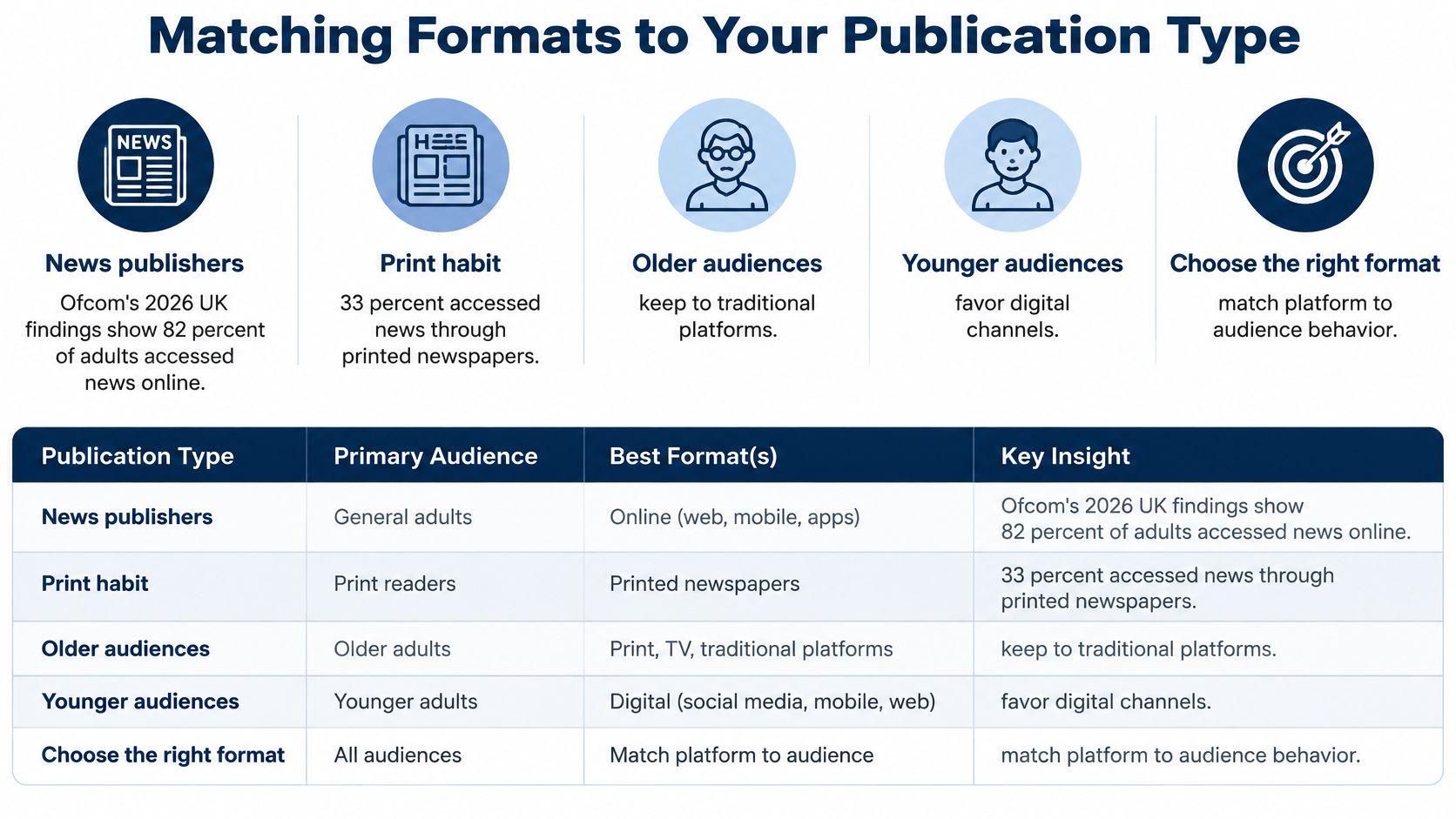
Ofcom's 2026 UK findings reported that 82% of adults accessed news online and 33% through printed newspapers, with older groups favoring traditional platforms and younger groups favoring online platforms, search engines and social media, according to its news consumption findings. These news habits provide context, not a substitute for surveying your own members, customers or employees.
Start with the job each publication performs. A membership benefit, an advertiser-supported trade title and a client relationship magazine don't need identical distribution.
Format mix by publication type
| Publication type | Primary format | Supporting format | Why this mix works |
|---|---|---|---|
| Association member magazine | Print member magazine | Searchable digital articles between issues | Print serves members who value the physical issue; digital keeps content current and findable |
| Trade publication | Fixed-layout digital edition for advertisers | Responsive HTML article stream | The fixed layout retains agreed ad placement and design; articles support mobile discovery |
| Corporate client magazine | Controlled PDF or viewer edition | Responsive articles for employees and prospects | Approved brand presentation remains intact while articles serve phone readers |
Apply the mix to an actual editorial purpose
For an association magazine, say the print issue contains member profiles, professional guidance and a substantial policy feature. Keep that curated issue for members who want it, while publishing searchable updates when guidance changes. Ask members about delivery preferences instead of treating age as a reliable individual predictor.
A trade publication can retain a designed edition with stable advertising positions and publish selected articles for mobile discovery. Its commercial team should distinguish edition inventory from article-page inventory so sponsors understand what they're buying. Don't imply that a responsive article preserves the surrounding print advertisement unless it does.
For a corporate client magazine, an approved PDF or controlled viewer edition can preserve presentation for account teams. Responsive articles can provide a convenient route to selected features for prospects or employees. Separate public material from confidential client content before creating shareable article versions.
A hybrid workflow makes sense when approved content must serve clearly different reading contexts. It's less attractive when the team can't maintain the extra versions, permissions and corrections.
Choose the channel for the moment
Print remains useful for event handouts, reception areas, tangible member benefits and intentional offline reading. Its value lies in being physically available at the right moment, not in an unsupported promise that every reader will pay closer attention.
Digital adds value when readers need current information, searchable archives, shareable articles or a direct route to an action. Identified-reader measurement can help sales and marketing teams, provided access rules and consent practices match the purpose.
Before choosing, answer:
- Who must receive it? Identify actual preferences, device access and delivery constraints.
- What should readers do? Distinguish reading for reference from subscribing, registering or contacting a representative.
- Who will maintain it? Name the owners of production, accessibility, corrections and reporting.
Print-only and digital-only remain valid choices when those answers support them. A combination is useful only when each channel earns its place.
Keep Your Print Design and Expand the Digital Experience
A signed-off print PDF can stay the source of truth while digital versions do different jobs: a downloadable PDF for easy distribution, a fixed-layout viewer for the designed edition, and responsive HTML articles for phone reading. Treat those as added channels with separate checks, not as automatic replacements for print.
- Keep the approved PDF as the master file. Preserve the signed-off design and record its version so digital enhancements do not obscure the original editorial approval.
- Import it into Creative Studio. Use the existing pages as the starting point rather than rebuilding the print piece solely to test digital delivery.
- Add purposeful interaction. Introduce links, forms and embedded media where they help readers act or understand. Keep an interaction inventory so reviewers can test every addition.
- Choose the delivery surface. Joomag's publishing options include standalone viewers, content hubs, website embeds and native mobile apps. Match the route to audience access, confidentiality and the action expected after reading.
- Prepare mobile-friendly articles. Use Article View to create a reflowing reading option, then review the extracted material against the approved source.
- Offer Accessibility Mode. Treat it as an additional reading option, alongside accessible content preparation and testing.
- Review before release. Confirm feature names, plan availability and setup requirements in current Joomag documentation before committing the workflow.
A designed viewer and an article view serve different preferences. The viewer retains page composition for readers who want the edition experience; the article option gives phone readers a text-led route through the same editorial material. For that phone-specific version, evaluate Joomag's mobile reading experience alongside the fixed-layout viewer before deciding which features need responsive articles.

Conversion is a draft, not editorial approval
Automated extraction still needs a human editor. A visually obvious distinction between a sidebar, caption and main story may not survive conversion in the intended order.
Check the converted content against a release checklist:
- Reading order: Confirm that columns, sidebars, pull quotes and footnotes appear in a sensible sequence.
- Headings and captions: Preserve hierarchy and keep image explanations attached to the correct material.
- Alternative text: Describe informative images appropriately and avoid duplicating unnecessary decorative content.
- Links and forms: Test destinations, labels, submission routes and permission requirements.
- Brand consistency: Review typography, image treatment, names and approved terminology.
- Factual accuracy: Compare figures, quotations, punctuation and proper nouns with the approved issue.
Give an editor responsibility for textual accuracy and a production owner responsibility for functional testing. They should inspect the published output, not only the editing preview.
Keep the approved design. Approve the converted reading experience separately.
The practical split is ownership: print keeps the approved layout stable, while each digital channel earns approval for order, access, interaction and measurement before release.
Test One Issue on Joomag Across Print, Desktop and Mobile
Run the comparison on an issue that already exists in print, so the editorial content stays constant while only the format changes. The test also separates three digital forms that are often lumped together: a downloadable PDF, a fixed-layout desktop edition, and responsive mobile articles. Each one can produce a different result, so measure them individually.
- Select an issue with a printed edition. Include a representative feature, images and a clear reader action.
- Read the same feature in each format. Compare the printed copy, the fixed-layout desktop edition and the responsive article view on mobile. Record reading time and points of friction without assuming faster is better.
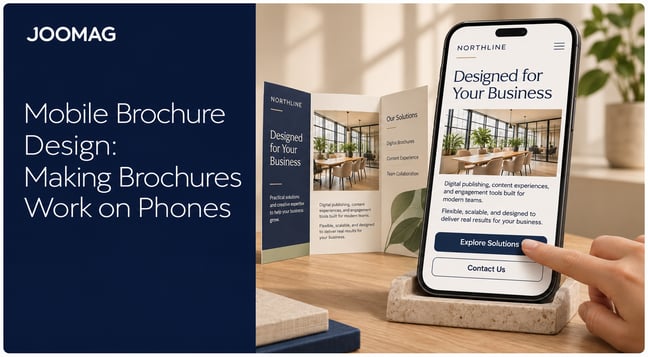
- Test the phone experience. Check text sizing, navigation, links and forms on the devices your audience uses.
- Inspect the desktop edition. Confirm that spreads, captions, advertising and approved branding remain correct.
- Review reporting after a week. Examine available identified-reader activity, repeat visits and link clicks. Note what remains anonymous or unmeasured.
Use the opening comparison table as your scorecard, weighting only the criteria that matter to your team. Include editorial review time and reader feedback alongside technical functionality, since a format that tests well on paper can still add hours to production.
A platform such as Joomag's digital publishing solution can turn an approved PDF into an interactive publication and adapt the content for mobile. Check current setup details before uploading the test issue.
Joomag also provides additional reading options and measures digital engagement, so one existing issue is enough to see how its print design, desktop edition and mobile articles serve your readers. The best format mix is the one your audience and operating evidence support, rather than a rule that digital must replace print.